.svg)
Application Detection & Response
Stop attacks at the first malicious action
Kodem ADR uses Exploit Trigger Defense to identify and stop threats the moment they begin, before they become breaches. Most application detection and response tools detect symptoms. Kodem detects intent.

“Kodem’s ADR tool gives us signal, not noise. It detects the first function call in the exploit path, before damage happens. That precision lets our team move quickly and trust what the system is telling us.”

ADR Explained
What is Application Detection and Response (ADR)
Application Detection and Response (ADR) is a category of runtime application security that identifies and stops exploits at the moment they begin executing in a production application. Unlike perimeter tools that watch network traffic or endpoint tools that watch operating system behavior, an ADR platform watches the application itself: the functions being called, the inputs being processed, and the execution paths being triggered.
Kodem’s ADR software, powered by Exploit Trigger Defense, captures the earliest sign of compromise without code instrumentation, application restarts, or performance overhead. It works across monoliths, microservices, and containers, and gives security and engineering teams a single source of truth for what is actually being exploited in production, rather than what might theoretically be vulnerable.
The Problem
Application exploits begin long before damage is detected
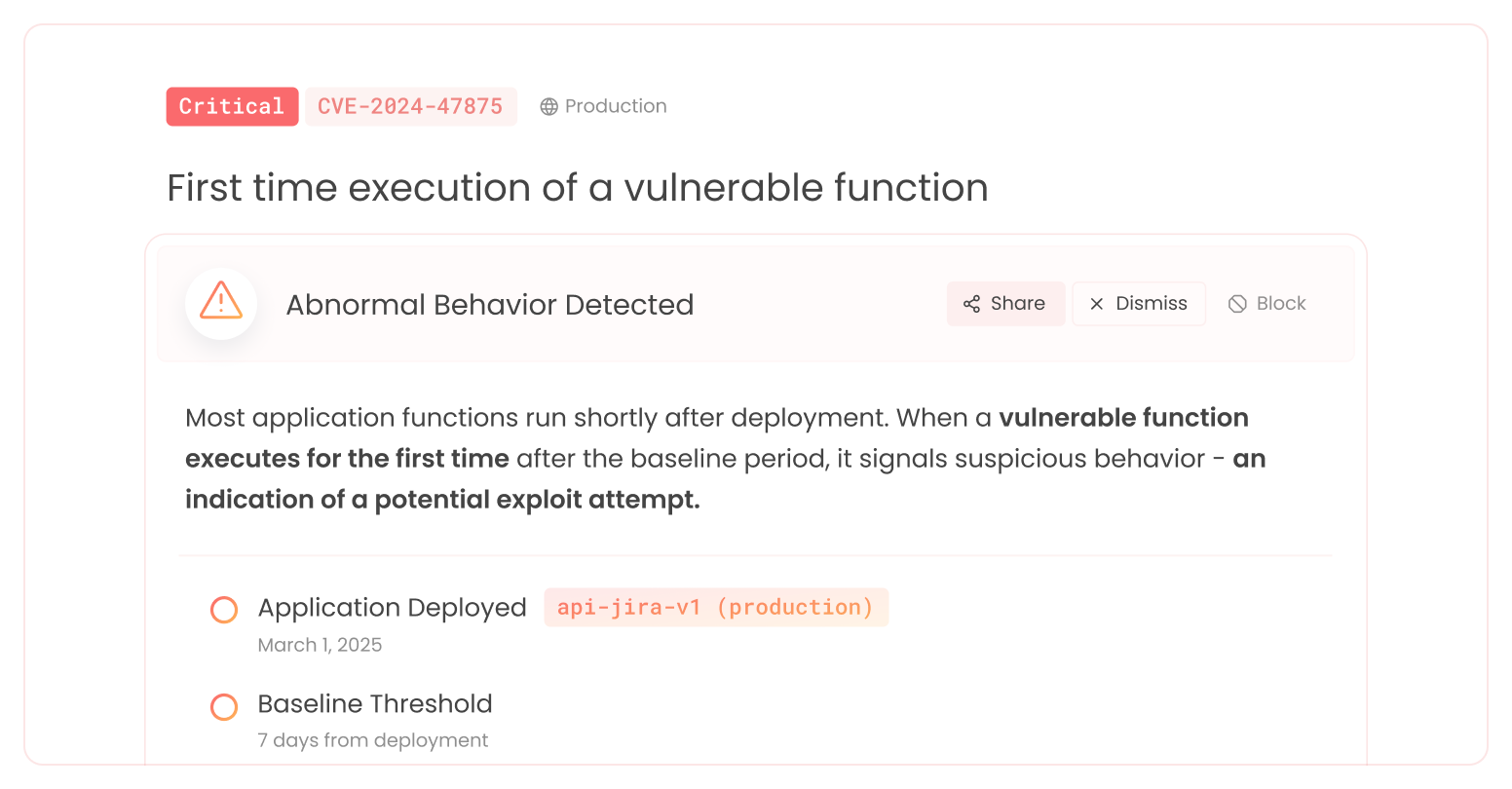
Traditional ADR tools monitor symptoms: outbound traffic, logs, crashes. But the exploit started earlier: when a vulnerable function was triggered, when logic was bypassed, or when user input reached a dangerous code path. Most tools miss this critical first step.
The Solution
Introducing Exploit Trigger Defense
Kodem ADR detects the initial trigger that launches the exploit path. This means no waiting for signatures or CVEs. No chasing logs after the fact. Just precise, real-time defense at the source.


First-Action Detection & Response
We capture the earliest sign of compromise by monitoring actual execution of vulnerable or sensitive functions.

CVE and Rule Agnostic
Kodem understands the normal behavior of every package and identifies when something deviates—even if it’s a zero-day or a logic flaw.

ADR Built for Production
Lightweight, out-of-band, and deployable without application restarts or code changes.

Exploit-Aware Correlation
We combine runtime signals, code context, and execution flow to confirm exploitability with high precision and connect the point of exploit to the line of code causing it.
ADR vs WAF vs RASP vs EDR
Four approaches to defending applications and infrastructure. Only one watches what your application is actually doing at the moment of exploit.
"Kodem’s application detection and response software delivers real-world results with virtually no false positives."

"Kodem's platform offers one of the strongest solutions available, delivering real-world results with virtually no false positives."



Prevent exploitation, not just detect it

Zero performance impact on end users

No code instrumentation or restart required

Works across monoliths, microservices, and containers

Application Detection & Response (ADR)
:
What to Know
Application Detection and Response (ADR) is a runtime application security category that detects and stops exploits at the moment they begin executing inside a production application. An ADR platform monitors function-level execution, learns the normal behavior of every package, and surfaces deviations in real time. Unlike WAFs that watch network traffic or EDRs that watch operating system processes, ADR sees what the application itself is actually doing.
A WAF inspects HTTP traffic at the network edge using pattern matching. A RASP runs inside the application via code instrumentation and applies rule-based input validation. ADR watches function-level execution inside the running application without instrumentation, learns normal behavior, and detects when the application deviates. ADR catches logic flaws, zero-days, and bypassed controls that WAFs and RASPs miss.
Yes. Because Kodem ADR learns the normal execution behavior of every package and function in your application, it surfaces deviations in real time without requiring a CVE or signature. When a previously unknown vulnerability is exploited, the resulting function call pattern looks abnormal to Kodem and triggers detection.
Kodem ADR does not. It deploys as an out-of-band sensor that observes runtime execution without modifying application code, requiring restarts, or adding latency to user requests. This is the operational difference between ADR and RASP, which requires in-app instrumentation.
Exploit Trigger Defense is the detection methodology that powers Kodem ADR. It identifies the initial function call that launches an exploit path, the moment a vulnerable function is invoked with attacker-controlled input, rather than waiting for a downstream symptom like an outbound connection or a log anomaly. This lets Kodem stop attacks at their first action inside the application.
Kodem ADR runs across cloud-native environments including Kubernetes, container, virtual machine, and hypervisor workloads. It also operates in air-gapped environments. The external analyzer plus in-host sensor architecture covers monoliths, microservices, and containers without performance impact on end users.
Legacy tools watch network traffic, OS behavior, or rule-defined inputs. Kodem ADR watches function-level execution inside the application itself. It detects exploits at the first malicious action, not after damage is done. It does this without code instrumentation, application restarts, or performance overhead, and it correlates exploit signals to the exact line of code causing the issue.