

See every AI agent.
Attribute every action.
Verify every control.
AI agents often share one process, one service account, and one network path. Kodem reconstructs the runtime agent hierarchy, including the tools, MCP servers, models, credentials, and data relationships behind it, so you can identify reachable risk, enforce agent-aware policy, and verify remediation.

AI-SPM that sees what inventories and network telemetry miss
One service hides many decision-makers
One service. Multiple agents.
Several agents share one service account, so security tools can't tell them apart or attribute a sensitive action to the specific agent behind it.
The agent structure stays invisible.
Watching traffic misses how the system is composed: sub-agent delegations, local models, and workflow dependencies.
From visibility to agent-aware control
Discover
Inventory every agent, model, tool, MCP server, and guardrail from runtime evidence.

Understand
Combine action origin, asset, and execution context. Classify what data can reach each model and where it can go.
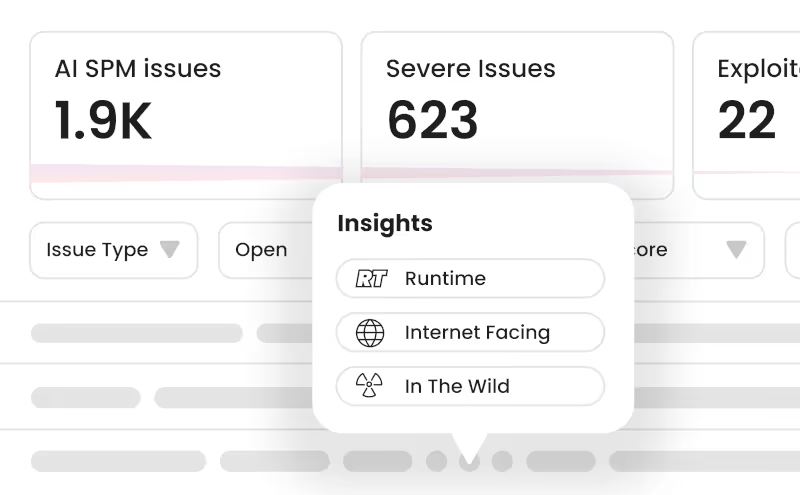
Govern
Define policy on the relationship between each agent, model, tool, data source, and delegated permission.
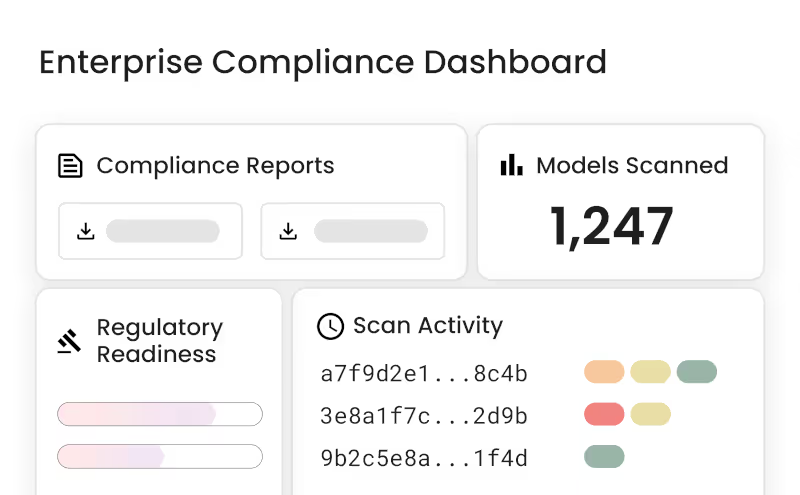
Enforce and verify
Send the originating agent and its runtime context to your AI gateway or enforcement layer for precise, per-agent control, then reconstruct runtime state to confirm the risky path is gone and legitimate workflows still work.
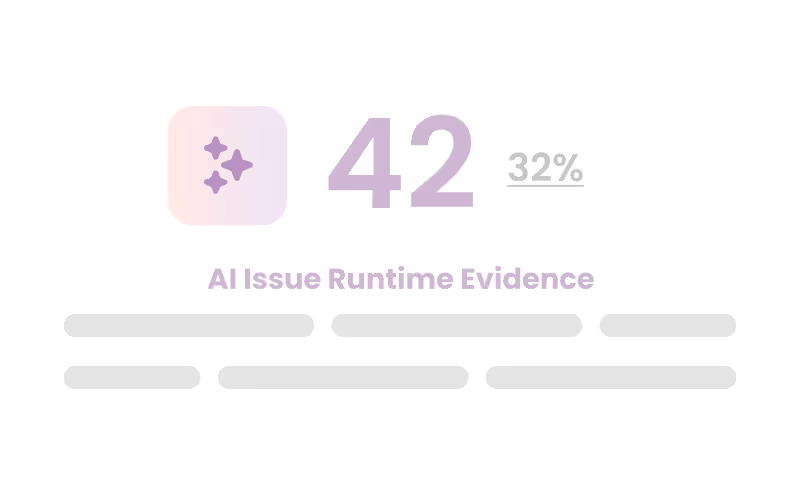
Agent-aware policy
A summary agent may read customer history but cannot invoke the refund tool. Only the refund agent may issue a refund, after approval, within the active order.
Precise enforcement
Allow or deny per agent, per delegation, with a targeted mitigation that preserves the rest of the service.
Verified remediation
Prove the action changed the outcome by re-inspecting runtime state, rather than waiting for the event to recur.
Attribution from memory
Kodem reconstructs the runtime agent hierarchy and binds each model, tool, and network interaction to its originating agent and delegation chain. That turns one shared workload into a precise, per-agent control signal.
The full causal chain
Kodem retains both the initiating agent and the immediate executor. This prevents an authorized tool from acting on behalf of an unauthorized agent, and lets policy follow delegation across MCP and agent-to-agent boundaries.


The originating agent is the missing control signal for the AI running inside your applications.
Give your AI gateway the agent behind every interaction
Kodem binds each model, tool, and network interaction to the agent that originated it: its parent, delegation chain, credential, and data context. With that signal, your AI gateway or enforcement layer can allow, require approval, restrict, or block based on the agent that acted, not just the shared service account.
Agent-aware policy and enforcement is the direction we are building with design partners. Today, Kodem delivers the attribution and reachable-risk evidence that makes it possible.
Frequently Asked Questions
It is Kodem's runtime intelligence extended to the AI layer: reconstructing every agent, tool, MCP server, and model running inside your applications from runtime evidence, so you can see and prioritize AI risk from what actually runs rather than from a manifest or a questionnaire.
An AI-BOM lists packages. A network scanner sees traffic to a model provider. Neither can see local model loads, in-memory delegation between agents, hidden credentials, or the tool registry that defines what an agent may do. Kodem reads the running process, so it shows the loaded truth.
No. The dataflow shows what can happen, drawn from how the agent is wired: which paths are reachable and where data can go. It surfaces reachable risk before it fires. It is not a recording of traffic that already moved.
AI security posture management (AI-SPM) is the practice of discovering and prioritizing security risk across the components of an AI application: its agents, models, prompts, tools, and data. Kodem delivers AI-SPM as agent-aware runtime intelligence, reconstructing what actually runs inside the workload from runtime evidence and mapping reachable risk to the OWASP LLM Top 10.
Kodem reconstructs the AI components running inside your applications from runtime evidence: the agents, the tools and MCP servers they can call, the models they bind (including local models that never touch the network), and the guardrails actually loaded. Each component is tied to the repo, image, and application it runs from, so ownership and reachable risk come from the same evidence.