

.svg)
Kodem goes beyond traditional software composition analysis by connecting vulnerable packages to real runtime context. We show you which dependencies are loaded, executed, and attacker-reachable, so you can prioritize what's truly at risk in production, not just what's listed in a manifest.
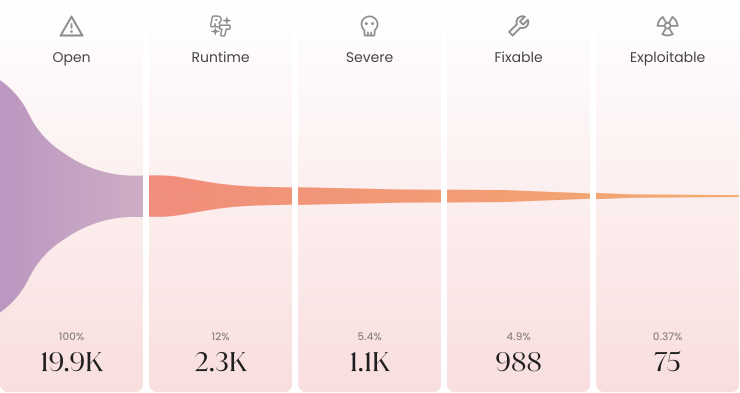
Every dependency scanner we ran buried us in vulnerabilities that were technically present but never actually executed. Kodem was the first to show us which open-source risks are truly reachable in production. My team finally spends its time on the packages that can actually be used against us, not on a backlog of theoretical CVEs.

From source code to containers and runtime behavior, Kodem connects the dots across your environment. We show you which vulnerabilities are active, exploitable, and matter most, so your team can focus on what attackers can actually reach and run.

Kodem analyzes code, libraries, containers, and infrastructure together, surfacing cross-layer issues and attack paths that siloed tools miss.

We trace function-level execution to highlight which CVEs are live in production. You stop fixing unused code and start fixing real exposure.

Kodem models how attackers can link multiple vulnerabilities across layers into a real exploit path, so you can break that path, not just patch one bug.

Kodem ranks findings with CISA KEV, EPSS, and exploit-maturity signals on top of runtime reachability, network exposure, and deployment stage, so you fix what attackers can actually exploit, not what is theoretical.
Kodem flags packages that load at runtime but never appear in your manifest, and detects typosquatting, dependency confusion, and compromised packages using public advisories and Kodem's own KOD advisory database as a CVE Numbering Authority.
Produce a continuously updated SBOM in CycloneDX and SPDX, enriched with runtime evidence so auditors see not just what is installed, but what actually runs.


SCA security, short for Software Composition Analysis security, is the process of finding and managing vulnerabilities in the open-source and third-party packages used in your applications. A modern SCA security platform tracks every direct and transitive dependency, maps each one to known CVEs, and tells you which of those vulnerabilities are actually reachable in your environment.
Static SCA scans your package manifest (package.json, pom.xml, requirements.txt, and similar) and flags every CVE in every declared dependency. Runtime SCA goes further. It traces which packages are actually loaded into memory and which functions are executed during production workloads. Runtime SCA eliminates vulnerabilities in code that never runs, removing the large majority of false positives so your team triages far less noise.
Reachability analysis determines whether a vulnerable function in a dependency is actually invoked by your application code. A CVE in an unreached function poses no real risk. Kodem's reachability analysis combines static call graph mapping with runtime execution data, so your team only triages vulnerabilities that attackers can actually exploit.
Transitive dependencies are the packages that your direct dependencies rely on. A single npm install can pull in hundreds of transitive packages, and most open-source vulnerabilities live in transitive code. A strong SCA security tool maps the full dependency tree, including OS-level and container packages, so nothing hides from view.
Yes. Kodem produces a continuously updated Software Bill of Materials (SBOM) in standard CycloneDX and SPDX formats, covering application libraries, container layers, and OS packages. The SBOM is enriched with runtime execution data, so you can show auditors not just what is installed, but what is actually running in production.
Kodem supports cloud-native environments including Kubernetes, container, virtual machines, and hypervisors. It also runs in air-gapped environments. The external analyzer plus in-host sensor architecture means Kodem works across CI/CD, staging, and production without adding significant overhead.
Legacy SCA tools rank vulnerabilities by CVSS score and dependency declaration. They produce findings without context. Kodem ranks vulnerabilities by runtime exploitability, asking: is the vulnerable function loaded, is it executed, is the call path attacker-reachable, and is the exposure present in your specific environment? That context-aware model shrinks the queue to the vulnerabilities that are genuinely exploitable.