Agentic AI Security: Securing AI Agents and the Systems They Touch
Agentic AI security is the practice of securing AI agents, the systems that let a model plan, call tools, use memory, and take actions on its own. The risk is rarely the model alone. It is what the agent is connected to and allowed to do. Because an agent turns model output into real actions, the durable defense is to contain capability and watch behavior at runtime, not to perfect the prompt.


What is agentic AI security?
Agentic AI security covers the controls that keep an AI agent from being turned into an attacker's tool. An agent is a model wrapped in orchestration: it can read context, decide on a step, call a tool or API, write to memory, and repeat. Each of those capabilities is useful, and each is attack surface. Agentic AI security is application security for that loop, with prioritization driven by what the agent can actually do in production rather than by what the model might say.
The shift from chatbots to agents changes the threat model. A chatbot returns text. An agent takes actions: it queries databases, sends requests, edits files, moves money. That is why most serious agent failures are authorization and orchestration failures, not model failures.
Why AI agents expand the attack surface
Four properties make agents riskier than a standalone model: autonomy (actions execute without a human in the loop), tool access (the agent can reach databases, APIs, shells, and other systems), memory (state is written and reused across steps, so a bad input can persist), and composition (agents call other agents and tools through protocols like MCP, so a foothold in one can cascade). The more capable the agent, the larger the blast radius when something goes wrong.
The main agentic AI risks
- Prompt injection as initial access. Crafted input, often indirect, redirects the agent. See what prompt injection is. It is the entry point, not the damage.
- Excessive agency and over-privileged tools. An agent with broad scopes can do broad harm once influenced. Least privilege is the single highest-leverage control.
- Tool and MCP abuse. Tools and Model Context Protocol servers extend what an agent can reach; unvalidated arguments and over-trusted tool output turn them into execution paths.
- Memory poisoning. Writable, reused memory lets an attacker plant instructions that resurface later.
- Multi-agent cascades. When agents call agents, a compromise propagates through the workflow. See multi-agent architectures and agent-framework security.
How to secure AI agents
Secure the system around the model, and assume the model will be influenced:
- Least-privilege tools and scopes for every agent.
- Validate tool arguments against policy before execution, rather than trusting model output.
- Sandbox execution and separate domains so file, network, retrieval, and memory access are constrained.
- Gate irreversible actions (payments, access changes, deletions) behind explicit confirmation.
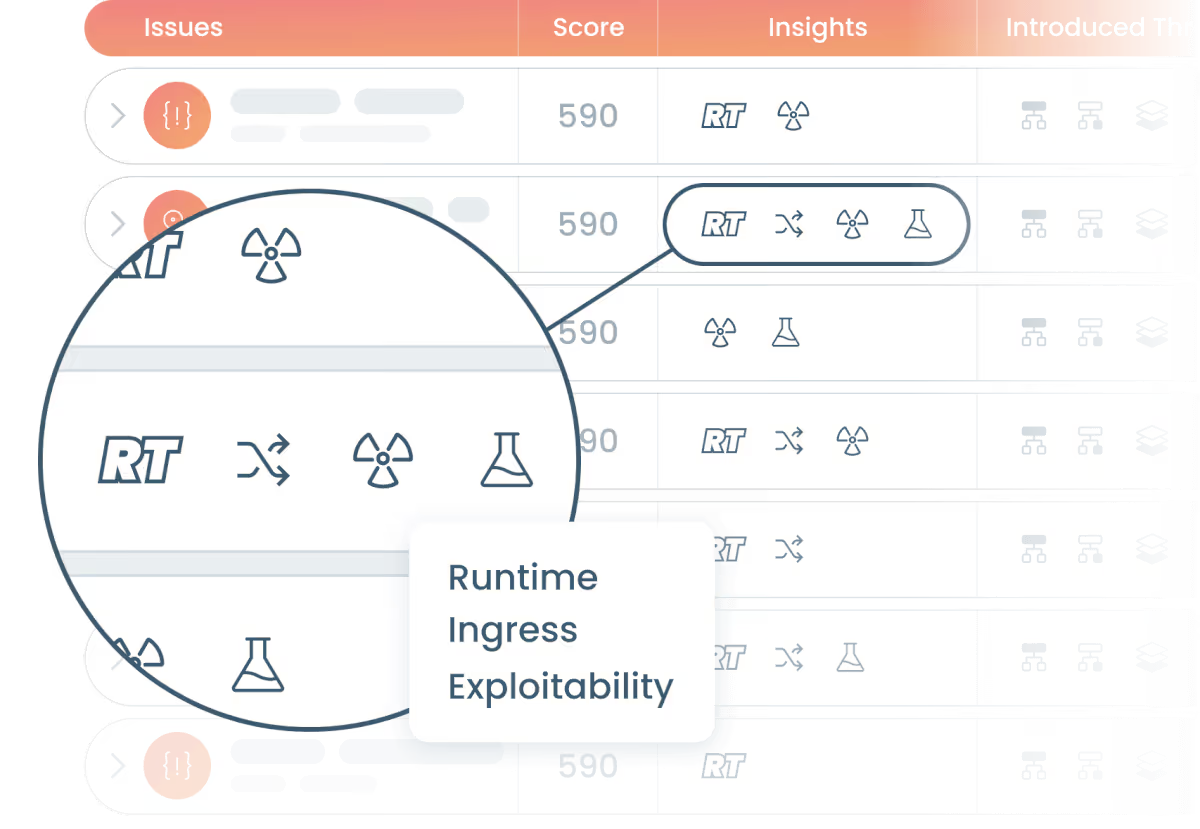
- Monitor at runtime: observe the tool calls, arguments, side effects, and cross-system pivots the agent actually performs, so an influenced action is caught when it executes.
This is where runtime intelligence matters: it reconstructs what each agent is and what it can reach from runtime evidence, not just what it was prompted. Kodem's approach to securing the AI application stack treats the agent as untrusted and prioritizes by what actually runs and what is reachable, and its application detection and response adds runtime protection at the application layer.
Agentic AI security and the wider AI stack
Agents are one layer of the AI application stack, and their risks chain with the others. Place agentic controls in the context of AI application security as a whole, and use the OWASP Top 10 for LLM Applications as the shared taxonomy.
Frequently Asked Questions
Agentic AI security is the practice of securing AI agents, the systems that let a model plan, call tools, use memory, and take actions autonomously. It focuses on containing what the agent can do and monitoring its behavior at runtime, since most agent failures are authorization and orchestration failures rather than model failures.
A chatbot returns text; an agent takes actions, such as calling tools, querying databases, or moving money. That turns model output into real-world effects, so the attack surface is the agent's tools, permissions, and memory, not just its responses.
Prompt injection as initial access, excessive agency and over-privileged tools, tool and MCP abuse, memory poisoning, and multi-agent cascades where a compromise propagates between agents.
MCP (Model Context Protocol) lets agents connect to external tools and data sources. MCP security means validating those connections and the arguments passed through them, and constraining what each tool can do, so an MCP server does not become an unguarded execution path.
Least-privilege tools and scopes, validated tool arguments, sandboxed execution, confirmation gates on irreversible actions, and runtime monitoring of the agent's real behavior.
Related blogs
Top 5 Malicious Package Detection Tools in 2026
Malicious package detection is not CVE scanning. Five tools compared on detection latency, ecosystem tiering, and whether they block or only alert.
14

Stop the waste.
Protect your environment with Kodem.
The State of the Application Security Workflow
This report aims to equip readers with actionable insights that can help future-proof their security programs. Kodem, the publisher of this report, purpose built a platform that bridges these gaps by unifying shift-left strategies with runtime monitoring and protection.
.avif)
Get real-time insights across the full stack…code, containers, OS, and memory
Watch how Kodem’s runtime security platform detects and blocks attacks before they cause damage. No guesswork. Just precise, automated protection.