Repository-Grounded Vulnerability Remediation for AI Security Engineers
Kai Automated Vulnerability Remediation and Pull Request Generation

AI-assisted vulnerability remediation is now a common capability across developer security platforms. GitHub, Snyk, Semgrep, GitLab, Sonar, Mobb, and general-purpose coding agents all provide mechanisms for generating code fixes from security findings.
The open question is not whether AI can suggest a patch. It is whether the patch is grounded in the affected repository, constrained by the original security finding, validated before presentation, and delivered in a workflow that product security teams can govern.
Kodem’s Kai Code Weakness Fix and Pull Request Generation capability is designed around that operating model.
Kai generates proposed fixes for eligible Code Weakness issues, explains the remediation, validates the change against the applicable rule, and allows teams to download a patch or open a pull request directly from Kodem.
The Remediation Challenge
Security teams have improved detection coverage across source code, dependencies, containers, infrastructure, and runtime systems. The primary bottleneck has shifted downstream.
Findings still require:
- Classification as true positive or likely false positive
- Repository and implementation context
- Secure patch construction
- Reviewable code diffs
- Developer routing
- Pull request creation
- Validation that the fix removed the weakness
- Assurance that the fix did not introduce a new issue
This work is expensive because remediation is contextual. A correct security fix depends on how the application is implemented, not only on the vulnerability class.
AI can reduce remediation latency, but only when the system constrains generation with security context and validation.
How Kai Compares to Snyk, Semgrep, and GitHub Copilot Autofix
Several vendors already offer AI-generated security fixes.
The market has validated the need for AI-assisted remediation. Kodem’s focus is narrower: make remediation reliable enough for product security teams to operationalize.
What Makes Automated Security Remediation Different
The unit of value is not an AI suggestion.
The unit of value is a validated, reviewable code change.
For Kai, this means:
- The finding must be eligible for fix generation.
- The issue should not be classified as a likely false positive.
- The proposed change must use repository context.
- The fix must address the applicable Code Weakness rule.
- The change must not introduce a new threat.
- The output must be inspectable by a human reviewer.
- The workflow must produce a patch or pull request.
This is the difference between generic AI code generation and governed security remediation.
Kai Code Weakness Fix and PR Generation
Kai can now generate fixes directly from eligible Kodem Code Weakness issues.
The workflow is available through the Generate Fix action.
Teams can:
- Generate a proposed remediation from the issue view
- Review the code diff
- Read the remediation explanation
- Download the patch
- Open a pull request from Kodem
Administrators can enable or disable the capability under:
Settings → Kai (Kodem AI) → Enable Kai to generate fix on demand
Access is permissioned.
Any user with access to the issue can generate and download a patch. Users with Operator permissions or above can open pull requests to GitHub, GitLab, and Bitbucket repositories. Azure Repos supports fix generation today, but not pull request creation. CI-uploaded repositories are not currently supported.
Case Study: Non-Literal Regular Expression
Figure 1. Code Weakness issue view
The first screenshot shows a Kodem issue titled Regular expression with non-literal value in src/utils/repo-workspace.ts.
The issue identifies a dynamic RegExp constructor. If attacker-controlled input reaches this constructor, the application can be exposed to Regular Expression Denial of Service. In Node.js, this class of issue can block the event loop and degrade application availability.
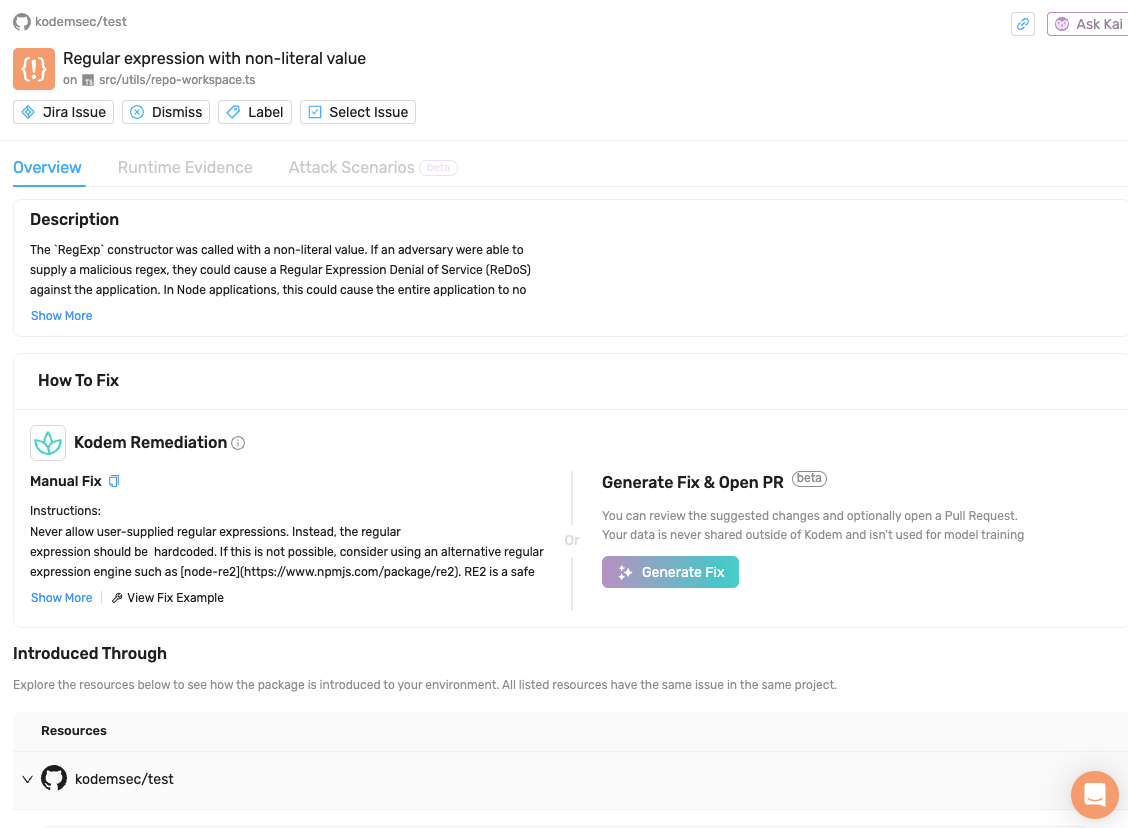
Kai remediation begins from an eligible Code Weakness issue, providing security context, remediation guidance and validation details before fix generation.
Figure 2. Kai-generated remediation
The second screenshot shows Kai generating a proposed code change.
The original code uses a dynamic regular expression to replace template tokens. Kai proposes replacing the dynamic RegExp path with a literal string replacement strategy using split and join.
This is the correct remediation pattern for the observed behavior.
The application is not trying to evaluate a regular expression. It is trying to replace a literal token. By moving from regex evaluation to literal string replacement, the fix preserves the intended behavior while removing attacker-controlled input from the regex execution path.
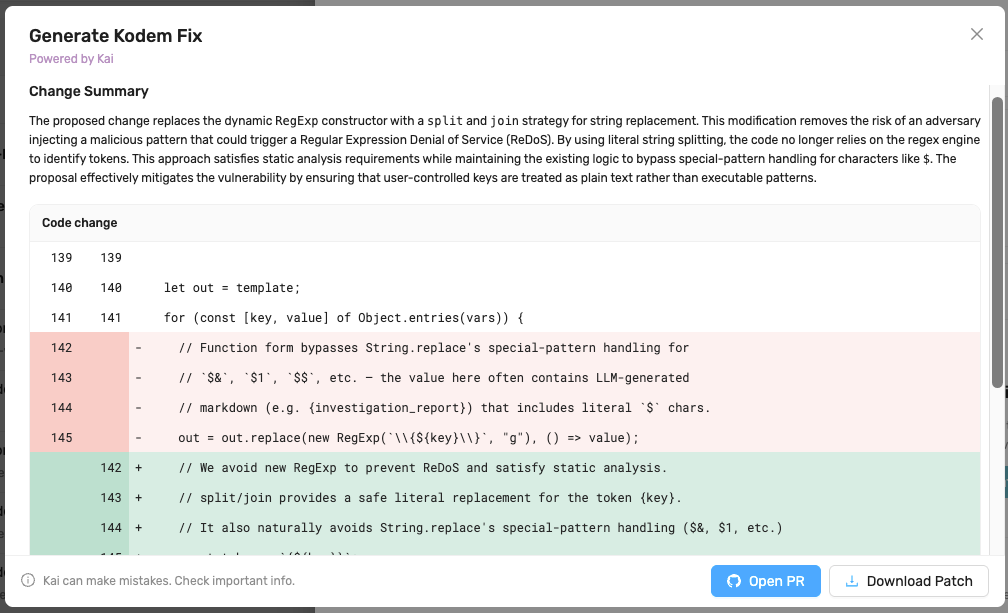
Kai generates a repository-grounded remediation, validates the change against the original issue and provides options to download a patch or create a pull request.
Why This Matters for AI Security Engineers
AI security engineers need remediation systems that are accurate, governable, and measurable.
A free-form coding agent can often produce a plausible patch. That is useful, but insufficient for security operations.
A product security remediation workflow needs stronger properties:
Kai is designed around these requirements.
Differentiation Summary
Beyond Code Weaknesses
AI-generated fixes are now table stakes.The more important product question is whether those fixes are trustworthy enough to fit into a product security workflow. Kodem’s answer is to constrain generation with issue context, repository context, false-positive filtering, rule validation, human review, and pull request workflow.
For AI security engineers, the value is: (1) less manual translation from finding to fix, (2) fewer unreviewable AI suggestions, and (3) a shorter path from validated weakness to merged remediation.
Related blogs

AI-BOM: How to Identify, Understand and Govern AI Supply Chain Risk
Kodem AI-BOM extends your SBOM with an AI bill of materials: identify AI packages, verify runtime execution, and govern AI supply chain risk at scale.
6

.avif)
Stop the waste.
Protect your environment with Kodem.
The State of the Application Security Workflow
This report aims to equip readers with actionable insights that can help future-proof their security programs. Kodem, the publisher of this report, purpose built a platform that bridges these gaps by unifying shift-left strategies with runtime monitoring and protection.
.avif)
Get real-time insights across the full stack…code, containers, OS, and memory
Watch how Kodem’s runtime security platform detects and blocks attacks before they cause damage. No guesswork. Just precise, automated protection.