AI Red Teaming: How to Test AI Systems for Risk
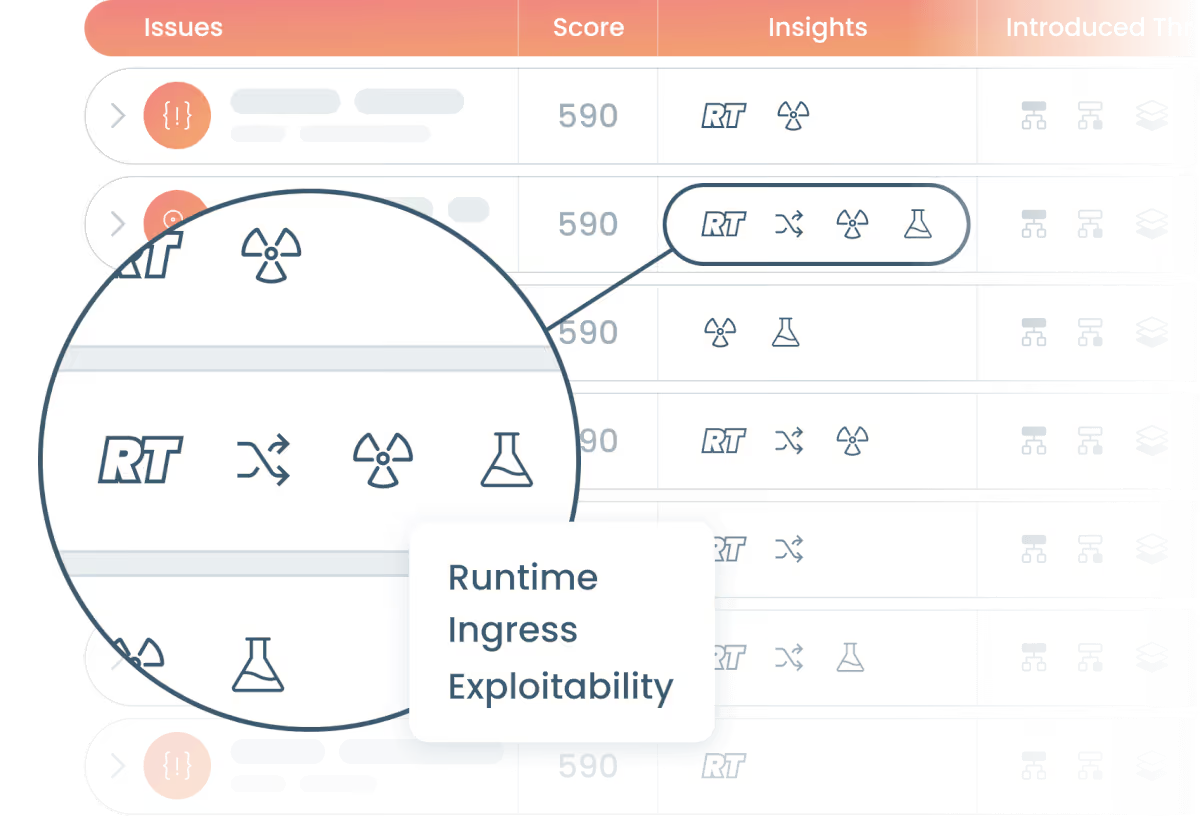
AI red teaming is the practice of adversarially testing AI systems, large language models, agents, and the applications around them, to find weaknesses before attackers do. It borrows from traditional red teaming but targets AI-specific failures like prompt injection, jailbreaks, data leakage, and agent abuse. Finding a weakness is only half the job: what matters operationally is whether that weakness is reachable and exploitable in production, which is a runtime question.


What is AI red teaming?
AI red teaming is structured adversarial testing of AI systems. A red team takes the attacker's perspective and tries to make a model or AI application behave in ways it should not: leak data, follow injected instructions, bypass its safety training, or misuse the tools it is connected to. The goal is to surface weaknesses, document how they are reached, and feed them back to the teams that can fix them. It is the AI counterpart to the red teaming security teams already run against networks and applications.
How AI red teaming differs from traditional red teaming
Traditional red teaming targets infrastructure, networks, and conventional application logic. AI red teaming adds a new attack surface: the model itself and the system wired around it. The inputs are natural language and data rather than only packets and payloads, the failures are often probabilistic rather than deterministic, and the same prompt can succeed once and fail the next time. That means AI red teaming leans on large, varied test sets and on understanding the full application, not just the model in isolation.
What AI red teaming tests
Most AI red teaming maps to the same risks defenders track in the OWASP taxonomy:
- Prompt injection and jailbreaks that redirect or unlock the model. See what prompt injection is.
- Sensitive data leakage from outputs, system prompts, or retrieval.
- Agent and tool abuse, where an influenced agent misuses its permissions. See agentic AI security.
- Supply-chain and model-integrity weaknesses in the components an AI app depends on.
The OWASP Top 10 for LLM Applications is the shared checklist most AI red teams work against.
Manual vs automated and agentic red teaming
Manual red teaming relies on human expertise and creativity; it goes deep but does not scale. Automated and increasingly agentic red teaming uses AI to generate and run attacks at scale, expanding coverage and finding issues continuously. Kodem's research has tracked this shift directly: see agentic red teams and autonomous vulnerability discovery, when o3 found a zero-day, and how OpenAI o1 changed offensive security.
Red teaming finds weaknesses, runtime tells you which ones matter
A red team can surface dozens of potential weaknesses. The operational question is which of them are actually reachable and exploitable in your running application, and which sit in code paths that never execute. That is where runtime intelligence comes in: it confirms what executes and is exposed, turning a long red-team report into the short list that genuinely matters. Kodem pairs this with Kai, its runtime-aware AI built to think like an attacker, and with its broader approach to securing the AI application stack, so findings are prioritized by real exploitability rather than theoretical severity. Place AI red teaming in the wider context of AI application security.
Frequently Asked Questions
AI red teaming is structured adversarial testing of AI systems, models, agents, and the applications around them, to find weaknesses such as prompt injection, jailbreaks, data leakage, and agent abuse before attackers do.
A penetration test targets infrastructure and conventional application logic; AI red teaming adds the model and its surrounding system as an attack surface, uses natural-language inputs, and deals with probabilistic rather than deterministic failures.
Prompt injection and jailbreaks, sensitive information disclosure, agent and tool abuse, and supply-chain or model-integrity weaknesses, broadly the risks in the OWASP Top 10 for LLM Applications.
Agentic red teaming uses AI agents to generate and run attacks at scale, continuously expanding coverage beyond what manual testing can reach.
Red teaming finds potential weaknesses; runtime intelligence confirms which are actually reachable and exploitable in production, so teams prioritize and defend the findings that represent real risk.
Related blogs
Top 5 Malicious Package Detection Tools in 2026
Malicious package detection is not CVE scanning. Five tools compared on detection latency, ecosystem tiering, and whether they block or only alert.
14

Stop the waste.
Protect your environment with Kodem.
The State of the Application Security Workflow
This report aims to equip readers with actionable insights that can help future-proof their security programs. Kodem, the publisher of this report, purpose built a platform that bridges these gaps by unifying shift-left strategies with runtime monitoring and protection.
.avif)
Get real-time insights across the full stack…code, containers, OS, and memory
Watch how Kodem’s runtime security platform detects and blocks attacks before they cause damage. No guesswork. Just precise, automated protection.