Top 5 AI SAST Tools in 2026: A Buyer's Guide
AI SAST is static application security testing with a machine-learning layer that reasons about code in context rather than only matching patterns. The category splits into two architectures. In AI-assisted SAST, a model triages, explains, or patches what a rule engine found. In AI-native SAST, the model participates in detection itself, which is what puts business-logic and authorization flaws in scope. The difference decides what the tool can find.

Every SAST vendor shipped an AI feature between 2024 and 2026, and the pitch converged on a single number: a 90 to 95 percent reduction in false positives. None of those figures has been independently replicated. Over the same period, measured security debt went up. Veracode's 2026 State of Software Security, built from 1.6 million applications and 141.3 million findings, reports that 82 percent of organizations carry security debt, an 11 percent rise year over year.
That gap between the claim and the outcome is why a buyer needs more than a feature matrix. This guide, current as of September 2026, covers five AI SAST tools, the six criteria that actually separate them, and the independent research worth having in hand before the first demo.
One disclosure before the list. Kodem publishes this guide and is one of the five. The list is not ranked, every claim traces to a public source, and each entry states its own limits, Kodem's included.
AI SAST splits into two architectures, and the split decides what gets found
AI SAST tools fall into two groups, and the distinction predicts capability better than any vendor's accuracy claim. AI-assisted SAST runs a deterministic rule engine first, then uses a model to triage, explain, or patch the output. AI-native SAST puts the model into detection itself, reasoning over a code graph rather than matching patterns.
The practical consequence is coverage. A rule engine finds what a rule describes: injection, deserialization, insecure cryptography, hardcoded secrets. A rule cannot describe "this endpoint checks authentication but the object it returns belongs to a different tenant." Broken access control, insecure direct object reference, and authorization gaps are the classes rule-based analysis structurally cannot reach, and they sit at the top of the OWASP Top 10. Reasoning-based detection is the honest reason to buy AI SAST at all. Noise reduction is the common reason, and the weaker one.
Both architectures carry the same dependency. A model reasons about the code it is shown, and neither one observes the application running.
Semgrep pairs a readable rule engine with an AI layer you can audit
Semgrep is AI-assisted by design, and the design is the point. The rule engine is open and inspectable, so any finding can be traced to the exact pattern that produced it. The AI layer, now branded Semgrep Multimodal, recommends triage decisions with a written rationale, generates fixes as pull requests, and stores per-project Memories: remediation instructions that persist so the same false positive is not re-argued every sprint.
Two details matter at evaluation time. Semgrep publishes list pricing, which almost nobody else in this category does, and the AI layer is metered by credits with a documented scope cap: auto-analysis covers critical and high findings on full scans, and up to ten new findings on diff-aware scans. That cap is a real constraint on a large monorepo and it is not on the marketing page.
Best fit: teams that want to read, tune, and own their detection logic, and that treat AI as an assistant to a rule set rather than a replacement for one.
Snyk Code combines symbolic analysis with a model trained on public code only
Snyk Code runs a hybrid engine, pairing symbolic analysis with generative models under the DeepCode AI name, and delivers findings and one-click fixes in the IDE and in pull requests. Adoption is the deepest in this set, and the developer experience is the reason.
The procurement-relevant fact is the training posture. Snyk states that its models are trained on permissively licensed open source projects with verified fixes, explicitly not on customer code. For a regulated buyer, that single sentence resolves a review question that other vendors leave open. Worth noting alongside it: Snyk's own pages currently quote autofix accuracy as both 80 percent and 85 percent depending on which page you land on, and the supported-language count is given as "19+" without an enumeration. Ask for the list in writing.
Best fit: organizations optimizing for developer adoption across a mixed estate, and those whose security review will ask where the model was trained.
GitHub Code Security publishes the limitations everyone else leaves out
GitHub pairs CodeQL, which performs genuine dataflow analysis rather than pattern matching, with Copilot Autofix for suggested remediation. No Copilot subscription is required. Since April 2025 the old bundle has been split, with Code Security and Secret Protection priced separately per active committer, so a 2026 evaluation should price the two lines independently.
GitHub's documentation is the most useful text in the category, and it is worth quoting to any vendor making stronger claims. The docs state that the system "may suggest fixes that fail to remediate the underlying vulnerability or introduce new vulnerabilities," that suggestions "might vary across attempts" for identical code, and that output can alter program semantics. Every AI SAST tool has these failure modes. One vendor writes them down.
The coverage limit to probe: autofix applies to a subset of queries within the default and security-extended CodeQL suites, not to every alert the scanner raises.
Best fit: GitHub-native organizations, where adoption friction is near zero and CodeQL's dataflow depth is already paid for.
Endor Labs reasons over a code graph to reach access-control classes
Endor Labs is AI-native. Multiple agents combine pattern matching, dataflow, and multi-pass model reasoning over a code context graph, and the stated target is the class rule engines miss: broken access control, insecure direct object reference, and authentication bypass. Language coverage is enumerated publicly, which is rarer than it should be, and spans Python, JavaScript, TypeScript, Java, Go, Rust, C and C++, C# and .NET, PHP, Ruby, Kotlin, Swift, and Scala.
Endor appears in Forrester's Agentic Development Security Tools landscape and not in Gartner's Magic Quadrant for Application Security Testing. That is a pattern across this category rather than a judgment on the product, and it is discussed below.
Best fit: teams whose backlog is dominated by logic and authorization defects rather than injection, and who can run a head-to-head against their existing scanner on a real repository.
Kodem runs its rule engine on an evidence layer the other four do not have
Kodem belongs on this list for one reason, and it is criterion six below rather than anything about the scanner. Kodem's SAST is built on Opengrep, the open-source engine Kodem co-founded and supports, with more than 1,000 maintained rules covering injection, deserialization, insecure cryptography, and exposed secrets including across git history. Taken alone that is a competent rule engine and not a reason to switch.
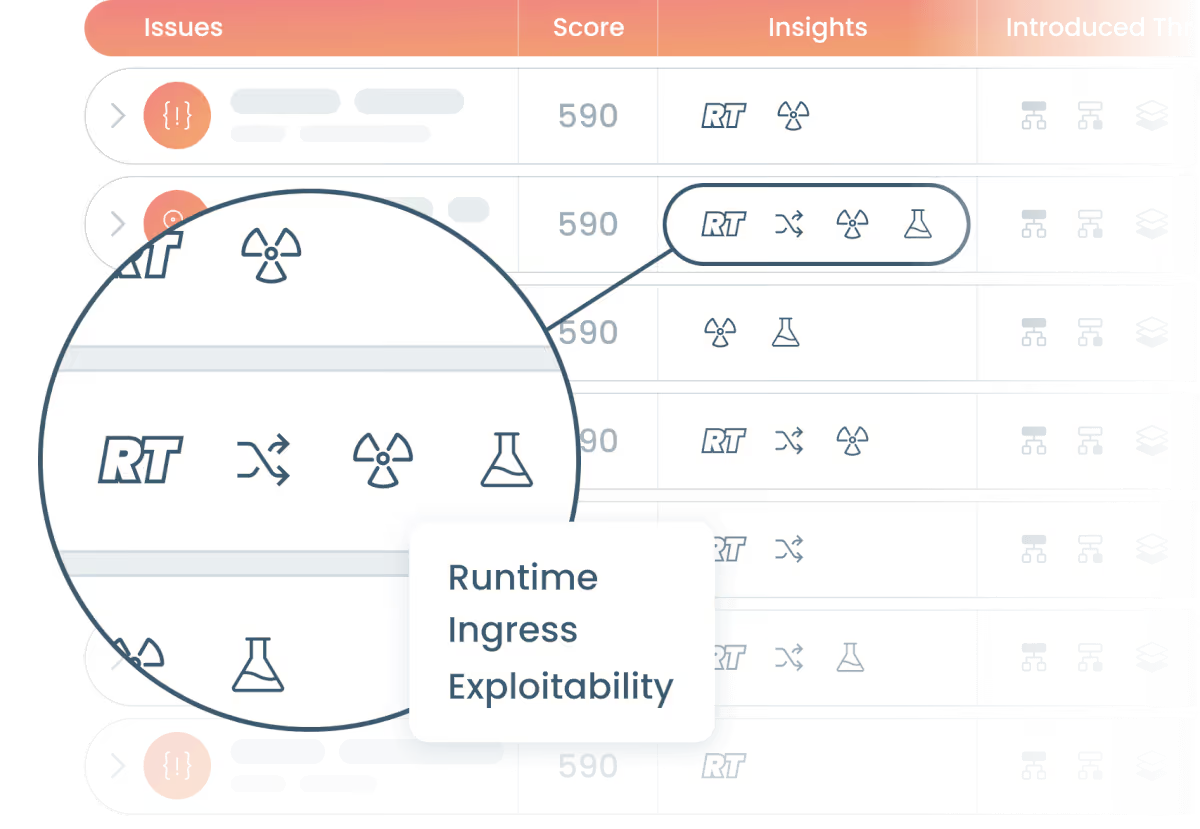
The difference sits underneath it. Runtime intelligence, a patented layer (US Patent 11,989,572 B2) built on eBPF and memory forensics, reads what a running process has actually loaded and which functions have executed, then correlates that back to the finding. A code weakness is ranked by whether its path is live in production rather than by severity alone. Kai, the AI layer, reasons over that evidence instead of the file in isolation: it separates likely false positives from confirmed issues, generates fix guidance and pull requests, and because the platform already holds current process state, it can confirm a fix landed without waiting for a new runtime event to arrive.
The limits, stated plainly. Kodem is not a better rule engine, and a buyer evaluating it as one will be underwhelmed. Function-level runtime execution, the strongest form of the evidence, is scoped to Python, Go, Java, JavaScript, TypeScript, Kotlin, Ruby, and Scala rather than every supported language, so ask where your stack lands. Sensors have to be deployed into the environments you want evidence from, which is a heavier adoption path than installing a source-control app. Pricing is not public.
Best fit: teams whose evaluation keeps producing accurate findings nobody has time to act on, where the missing input is not detection quality but which code actually runs.
The five tools differ most on architecture, transparency, and scope caps
| Tool | Architecture | Public pricing | Languages enumerated | Documented AI scope cap | Strongest for |
|---|---|---|---|---|---|
| Semgrep | AI-assisted, open rule engine | Yes | Yes | Yes, credits plus a per-scan finding cap | Auditable, tunable detection |
| Snyk Code | Hybrid symbolic and generative | No | No, "19+" unlisted | Not published | Developer adoption and training posture |
| GitHub Code Security | CodeQL dataflow plus Copilot Autofix | Yes, per active committer | Yes | Yes, a query subset | GitHub-native estates |
| Endor Labs | AI-native, multi-agent over a code graph | No | Yes | Not published | Access control and logic flaws |
| Kodem | Rule engine plus a runtime evidence layer | No | Yes | Not applicable | Ranking findings by what executes |
Also worth shortlisting depending on the gap: Checkmarx One, which runs its AI as three agents inside an enterprise platform and publishes the most specific triage claim in the category, a drop from 3.5 hours to 20 minutes per finding, which also makes it the most testable in a proof of concept; Veracode Fix, which grounds suggestions in expert-curated data rather than generated guesses and keeps a human in the loop by design; Aikido and Corgea, which publish full pricing at the low end; and ZeroPath, which covers AI-application vulnerability classes such as unsafe model-response handling and supports bring-your-own-key deployment. Two products frequently mislabeled as AI SAST are Mobb and Pixee. Both are remediation layers that consume another scanner's findings, so comparing either against Semgrep or Endor is a category error.
One entry belongs on no 2026 list. Amazon CodeGuru Security reached end of support in November 2025, and historical findings could not be migrated. Several competing listicles still recommend it. Amazon Q Developer is the current path.
Six criteria separate these tools, and four appear on no vendor page
Detection accuracy and language coverage are on every comparison page. The four below are not, and they are where evaluations are won or lost.
- Detection architecture. Ask whether the model participates in detection or only post-processes rule output. The answer predicts whether business-logic and authorization flaws are in scope at all.
- Run-to-run determinism. Contrast Security's AppSec Overflow 2026 study ran three AI AppSec tools over one codebase and found roughly 5 percent agreement between them. Running a single scanner three times against identical code reproduced 17 percent of its own findings. Ask every vendor to scan the same commit twice and diff the results. Contrast sells competing runtime tooling, so read the study with that in mind, and then run the test yourself.
- Who adjudicated the accuracy claim. An execution-calibrated study published in the Journal of Cybersecurity and Privacy in September 2026 found that model-based judges agreed with each other at kappa 0.75 but agreed with actual code execution at kappa 0.26 or lower. Two judges can reliably agree while both are wrong about what the code does. If a vendor's "95 percent false positive reduction" was adjudicated by a model rather than by running the code, the number describes an opinion.
- Whether fixes are tested before the pull request opens. A March 2026 analysis of 319 model-generated patches across 64 reproducible Java vulnerabilities found 24.8 percent fully correct. Only 13.2 percent failed to compile, so the dominant failure mode is code that builds and looks right. The most dangerous bucket, 10.3 percent, compiles, passes the existing test suite, and does not fix the vulnerability. Ask whether the tool executes its own fix against a proof-of-vulnerability test before proposing it.
- Data handling and training posture. Whether customer code leaves the environment, whether it trains a model, whether a private or customer-supplied model provider is supported. Snyk, Semgrep, and ZeroPath each answer this differently.
- Execution evidence. Ask whether anything in the evaluation can tell you that a flagged code path actually runs in production. Static analysis, AI-assisted or AI-native, reasons about what the code makes possible. Runtime intelligence is the separate layer that settles which of those possibilities is real, and it is the criterion most likely to be missing from the bake-off entirely.
Analyst coverage splits along the same line as the architecture
Gartner's Magic Quadrant for Application Security Testing, published in October 2025, names sixteen vendors including Semgrep, Snyk, Checkmarx, Veracode, and GitHub. None of the AI-native challengers appear in it. Forrester's Agentic Development Security Tools landscape, published in Q2 2026, covers a category Forrester notes did not exist a year earlier, and that is where Endor Labs, Cycode, and their peers show up.
A buyer anchored to a single analyst document will see only half the market. Forrester's six capability themes are the better vendor-neutral rubric of the two: contextual code and dependency analysis, guardrails for AI-assisted coding, exposure-based triage, validated automated remediation, supply chain and toolchain protection across coding agents and MCP servers, and governance analytics.
A two-week evaluation on your own repository beats a six-week bake-off
The cost of this category is not the licence. Contrast's study put the cost of scanning a two-million-line codebase at roughly 315 dollars in API charges, against roughly 128,000 dollars to triage the output. The economics move spend from detection to validation rather than removing it, which means the metric that matters is how much validation the tool removes, not how many findings it produces.
A short, evidence-first evaluation:
- Pick one repository with a real, aging backlog. Synthetic benchmarks reward pattern coverage and tell you nothing about noise on your code.
- Scan the same commit twice with each tool and diff the findings. Record the reproducibility rate.
- Take twenty findings each vendor marks as safe to ignore and have an engineer adjudicate them by reading the code. Measure agreement, not the vendor's claimed rate.
- Take ten proposed fixes, apply each on a branch, and run the test suite plus a proof-of-vulnerability test. Count how many compile, pass, and actually close the flaw.
- Ask each vendor, in writing, for the enumerated language list, the AI scope caps, and the training and data-residency posture.
- Separately, establish which findings correspond to code paths that execute in production. That number usually reorders the backlog more than any triage feature does.
Step six is the one most teams skip, and the one that most often changes the answer. Run it against whatever you shortlist, including the entry we publish. The longer explanation of what execution evidence does to a triage queue is in runtime-validated code security, and a walkthrough can run it against your own repository.
Frequently Asked Questions
AI SAST is static application security testing with a machine-learning layer that reasons about code in context. Some tools use the model only to triage or patch what a rule engine found. Others put the model into detection itself, which is what makes business-logic and authorization flaws reachable at all.
Traditional SAST matches patterns and dataflow against written rules, so it finds what a rule describes: injection, deserialization, weak cryptography, hardcoded secrets. AI SAST adds reasoning, which extends coverage toward classes no rule can express, such as an endpoint that authenticates the caller but returns another tenant's object.
The vendor claims cluster at 90 to 95 percent and none has been independently replicated. Contrast Security ran three AI AppSec tools over one codebase in 2026 and found roughly 5 percent agreement between them, and a single scanner reproduced only 17 percent of its own findings across three runs on identical code. Test reproducibility on your own repository before accepting any reduction figure.
They generate fixes, and the fixes are frequently wrong in a way that is hard to spot. A March 2026 study of 319 model-generated patches across 64 reproducible Java vulnerabilities found 24.8 percent fully correct, with only 13.2 percent failing to compile. The dominant failure mode is code that builds, reads correctly, and does not close the flaw. Human review and a proof-of-vulnerability test are both still required.
No. Every tool in this guide either wraps a deterministic engine or recommends running alongside one, and the AI-native products explicitly ingest other scanners' output. Treat AI as a layer on a rule set rather than a substitute for one.
Semgrep and GitHub publish list pricing and both have workable free tiers, which makes either a low-friction starting point. Aikido and Corgea also publish full pricing at the low end. Check the AI scope caps before committing, since free and entry tiers meter automated analysis and autofixes per month.
Ask what adjudicated it. A September 2026 execution-calibrated study found model-based judges agreeing with each other at kappa 0.75 while agreeing with actual code execution at kappa 0.26 or lower. If the accuracy figure was scored by another model rather than by running the code, it measures agreement, not correctness.
No. Static analysis of any kind reasons about what the code makes possible. Whether a vulnerable path actually loads and executes in production is a runtime question, answered by observing the running process, and it is usually the factor that reorders a backlog the most.
References
- Veracode: 2026 State of Software Security and GenAI Code Security Report
- Contrast Security AppSec Overflow 2026, reported by Help Net Security
- Why LLMs Fail: Failure Analysis for Automated Security Patch Generation (arXiv, March 2026)
- Fixing, Breaking, or Faking It? Execution-Calibrated Evaluation of LLM Vulnerability Patching (September 2026)
- OWASP: Source Code Analysis Tools
- GitHub: Responsible use of Copilot Autofix for code scanning
Related blogs
Top 5 Malicious Package Detection Tools in 2026
Malicious package detection is not CVE scanning. Five tools compared on detection latency, ecosystem tiering, and whether they block or only alert.
14


The State of the Application Security Workflow
This report aims to equip readers with actionable insights that can help future-proof their security programs. Kodem, the publisher of this report, purpose built a platform that bridges these gaps by unifying shift-left strategies with runtime monitoring and protection.
.avif)
Get real-time insights across the full stack…code, containers, OS, and memory
Watch how Kodem’s runtime security platform detects and blocks attacks before they cause damage. No guesswork. Just precise, automated protection.