Top 5 Malicious Package Detection Tools in 2026
Malicious package detection identifies open source packages authored or modified with intent to harm: typosquats, dependency-confusion packages, install-script malware, credential stealers, and self-propagating worms. The problem is distinct from CVE-based vulnerability scanning, because malicious packages almost never receive CVE identifiers and because the damage happens at install rather than months after disclosure.

Sonatype's 2026 State of the Software Supply Chain counted 454,648 new malicious packages published in 2025, more than 99 percent of them on npm. A CVE scanner will find none of them, and the reason is structural rather than a coverage gap: malicious packages almost never receive CVE identifiers, so tooling keyed to an identifier has nothing to match against.
This guide, current as of September 2026, covers five malicious package detection tools, the criteria that actually separate them, and the 2026 evasion techniques a shortlist should be tested against.
One disclosure before the list. Kodem publishes this guide and is one of the five. The list is not ranked, every claim traces to a public source, and each entry states its own limits, Kodem's included.
Malicious package detection asks a different question from vulnerability scanning
Software composition analysis asks whether a package version contains a known, disclosed defect. Malicious package detection asks whether the package was authored or modified with intent to harm. The two tool sets look adjacent on a slide and behave nothing alike in production.
The decisive difference is time. A CVE stays useful for months after disclosure, because the vulnerable code sits there until someone exploits it. A malicious package does its work at npm install, usually within minutes of publication, and the window closes. In the August 2026 ChainDrop compromise of keyv and cacheable, the campaign began at 09:00 UTC and spread across more than 400 packages the same day. Shai-Hulud 2.0 spawned roughly a thousand malicious repositories every thirty minutes. A malicious version of @bitwarden/cli was live for about ninety minutes in April 2026.
Provenance does not close the gap either. The August 2026 npm worm did not forge its attestations. The attacker took over a maintainer's GitHub account and triggered a release through the owner's own pipeline, so npm generated genuine provenance for a poisoned build. Provenance answers where a package came from. Whether the identity that triggered the build was authorized is a separate question.
Socket analyses package behavior and publishes timestamped detections
Socket performs behavioral analysis of the package code itself, flagging network calls, filesystem access, shell execution, obfuscation, and environment-variable exfiltration, rather than matching a known-bad list. Deployment spans a GitHub app for pull-request alerts, a CLI, a browser extension, and Socket Firewall, which blocks at install either as an install-command wrapper or as a registry proxy.
The detection claim is unusually auditable. When axios was compromised in March 2026, Socket published timestamps showing the malicious version flagged roughly six minutes after publication. Socket is also the only vendor in this set publishing a tiered language list rather than a flat one, and the tiering is worth reading before you buy: full behavioral support covers JavaScript and TypeScript, Python, Go, Java, Ruby, .NET, Scala, Kotlin, and Rust, while Swift, C and C++, Julia, Dart, and Elixir are CVE-only, meaning no malware detection at all.
Best fit: npm-heavy estates that want blocking at install and are willing to trade some breadth for behavioral depth.
Aikido detonates npm packages in a sandbox and publishes the feed free
Aikido runs the most transparently documented pipeline in the category: extraction and deobfuscation, static analysis using Opengrep and YARA-X, dynamic sandbox detonation for npm packages, model-based review across files to reconstruct the attack chain, and human researcher verification before publication.
Aikido publishes the strongest latency figures anyone has put in writing, a median under six minutes from release to analysis and most packages handled within eight. Coverage spans more than eighteen registries, which reaches past package managers into VS Code, Open VSX, JetBrains, and browser extension stores. That breadth matters more than it used to: the Red Hat npm compromise of May 2026, in which 32 @redhat-cloud-services packages were affected, began with a malicious VS Code extension taking over a maintainer's GitHub account.
The intelligence feed is free with an account, which makes Aikido a reasonable baseline even for teams that buy elsewhere.
Best fit: teams that want sandbox evidence rather than heuristics, and coverage that includes the developer tooling attackers now use as an entry point.
Sonatype Repository Firewall quarantines at ingestion rather than after the fact
Sonatype sits as a proxy in front of the registry and automatically quarantines suspicious components before they reach a developer or a build, releasing them if they clear. The architectural stance is prevention at ingestion rather than detection after download, and it is the oldest implementation of that idea at scale.
Ecosystem coverage is the broadest verified list in this set: npm, Maven, PyPI, NuGet, Docker, Go, Rust, PHP Composer, C++, and Hugging Face models. Deployment options include cloud, self-hosted, and air-gapped, which no SaaS-only competitor offers. Sonatype also runs the longest-standing dataset in the category, which is the source of the malware counts most of the industry quotes.
The caveat to raise in a demo: Sonatype does not publish its detection methodology, and its "3x more malware than competitors" claim carries no published comparison. Ask what quarantine does on a cache miss or a service outage, since a control that fails open is not a control.
Best fit: regulated and air-gapped environments, and polyglot estates where npm is only part of the problem.
JFrog Curation sidesteps the latency race with a maturity hold
JFrog Curation intercepts packages at the point of entry to Artifactory, blocking on known vulnerabilities, malicious code, operational risk, and licence policy, and substituting the next safe compliant version rather than simply failing the build.
The distinctive control is a 14-day immaturity policy that holds newly published versions before they are consumable. That is a structurally different answer from every other tool here. Instead of competing to detect a malicious package in six minutes, it removes the six-minute window entirely, at the cost of a two-week lag on legitimate releases. For an organisation that cannot win a latency race, this is the most effective single lever available, and it directly counters the worm pattern where packages are published and consumed within the hour.
Best fit: teams already standardised on Artifactory, and any organisation that would rather engineer away the race than try to win it.
Kodem covers the half of the problem that begins after installation
Kodem's place on this list is a narrow one, and the boundary comes first. Kodem is not a package firewall. It does not proxy a registry or intercept at npm install, which is precisely what the four tools above are built to do. For the interception layer, buy one of them.
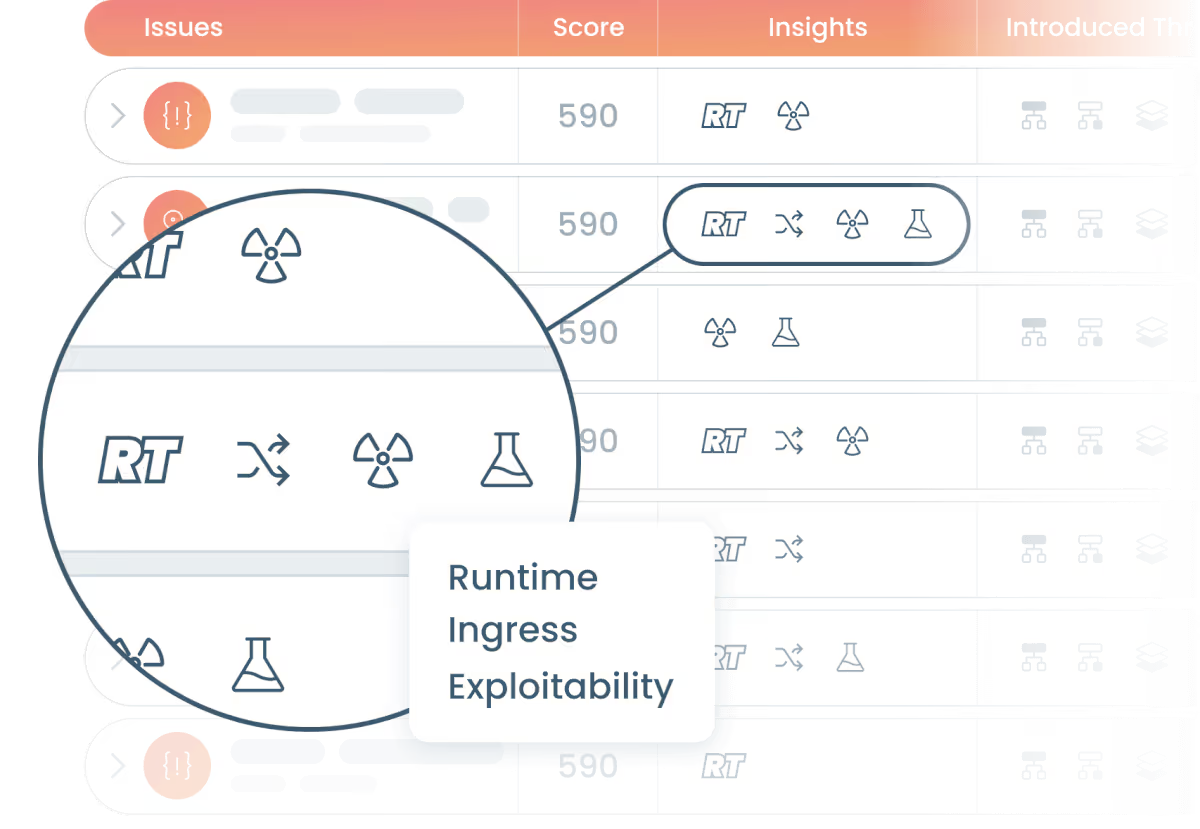
What Kodem adds starts once a package is on disk. Malicious package is its own issue type in the platform, scored at the top of the range by design rather than inheriting a CVSS it was never assigned, with detection across typosquatting, dependency confusion, and compromised packages in both direct and transitive dependencies through runtime-powered SCA. Container images are scanned for malware as well as vulnerabilities. The evidence underneath is runtime intelligence, a patented layer (US Patent 11,989,572 B2) built on eBPF and memory forensics that reads what a running process actually loaded and executed. That surfaces shadow dependencies present at runtime but absent from the manifest, which is the exact category a manifest-reading scanner cannot see.
When a package that got through starts doing what the payloads in this guide do, spawning a shell, reading credential files, opening an outbound connection, Application Detection and Response detects at the moment of exploit initiation rather than after compromise, without signatures. Enforcement sits at source control and CI: policies can block a merge or an image push, and can condition on whether an issue is confirmed in runtime rather than on severity alone.
The limits, stated plainly. No registry proxy and no install-time interception, so nothing here competes with a firewall on latency. Sensors have to be deployed where you want runtime evidence. Pricing is not public.
Best fit: teams that already run a package firewall and need an answer to what happens when one gets past it, or that are consolidating dependency risk, malware, and runtime detection instead of buying a fourth point tool.
The five tools differ most on latency, enforcement, and ecosystem tiering
| Tool | Primary method | Published latency | Enforcement | Ecosystem list published | Distinctive control |
|---|---|---|---|---|---|
| Socket | Behavioral static analysis of package code | 6 minutes, timestamped on axios | Blocks at install, wrapper or proxy | Yes, tiered | Tiered transparency on what is not covered |
| Aikido | Sandbox detonation plus static and model review | Median under 6 minutes | Blocks at install via Safe Chain | Yes, 18+ registries | Free public intelligence feed |
| Sonatype | Not published | Not published | Auto-quarantine at ingestion | Yes, broadest | Air-gapped deployment |
| JFrog Curation | Metadata, behavior, and provenance via JFrog Catalog | Not applicable by design | Blocks and substitutes a safe version | Partial | 14-day immaturity hold |
| Kodem | Runtime evidence after install, plus SCA and container malware scanning | Not applicable, post-install | Blocks a merge or image push, not an install | Yes | Behavioral detection of what got through |
Four more belong on a longer list. Endor Labs runs multi-agent behavioral analysis against a stated set of more than 150 proprietary signals and delivers a package firewall between the artifact repository and the public registry, with a policy engine that governs AI coding agents as well as human developers. Veracode Package Firewall is the successor to Phylum, whose technology Veracode acquired in January 2025, and its documentation is candidly specific: near-instant for a package already processed, roughly thirty minutes to acquire and analyse one it has never seen. ReversingLabs Spectra Assure is the answer for commercial binaries you did not build and have no source for, which nothing else here addresses. Chainguard belongs in a different column entirely, rebuilding libraries from verified source rather than detecting malice, which eliminates the problem for the ecosystems it covers instead of finding it.
For teams with no budget, the OpenSSF malicious-packages dataset is the vendor-neutral corpus several commercial products consume, and SafeDep's Apache-licensed vet runs static and dynamic analysis across npm, PyPI, Maven, Go, Ruby, Rust, and PHP as a CLI or CI step.
Five criteria separate these tools, and detection latency is only the first
- Detection latency against real attack speed. Compare the published figure to the incident timeline, not to a competitor. A tool detecting "within hours of discovery" would have intercepted none of ChainDrop, Shai-Hulud 2.0, or the 90-minute Bitwarden window. Ask for timestamps, not adjectives.
- Ecosystem coverage, tier by tier. "Supports npm and PyPI" conceals a great deal. Socket is the only vendor publishing which ecosystems get malware detection and which get CVE matching only. Demand the same tiering from everyone else, and note that the Miasma family reached Go in June 2026 and Shai-Hulud reached PyPI, so npm-only coverage no longer holds.
- Blocking versus alerting, and behavior on failure. Socket Firewall, Sonatype, JFrog Curation, Veracode, Endor, and Aikido Safe Chain all block at the registry or the install. Ask what happens on a cache miss or an outage. Fail-open defeats the control.
- Coverage of 2026 evasion techniques. Three specific probes, each grounded in a real campaign. Does the tool analyse
binding.gypand node-gyp install paths, which Miasma used in June 2026 to bypass lifecycle-script monitoring? Does it detect malware that executes onrequire()rather than at install, which the Flooding Dropper campaign of August 2026 used across 1,033 confirmed packages with no install hooks at all? Does it coverpreinstalland not justpostinstall, which both Shai-Hulud 2.0 and ChainDrop moved to? - Whether anything sees what the package does after installation. Four of the five tools in this guide stop at the install boundary. A March 2026 academic benchmark of eight open-source and research detectors across 6,420 malicious and 7,288 benign npm packages found precision ranging from 50 to 99 percent and recall from 44 to 99 percent, and machine-learning detectors degrading sharply over time as techniques shifted. The paper's core observation is the one to carry into a demo: legitimate and malicious packages call identical APIs, so the hard problem is distinguishing capability from intent. No commercial vendor in this category publishes a false positive rate. Something has to catch what gets through.
The install boundary is where most of this tooling ends
Red Hat's May 2026 incident is the most useful case study available, and not because of the detection. Thirty-two packages were compromised, and no Red Hat product shipped a poisoned version, because Red Hat's deployment process strips installation-time scripts before deployment. A structural control did what a detection race could not.
The same logic applies one layer further in. A malicious package that evades the firewall becomes a running process doing something the application never did before, and that behavior is observable even when the package was not. Structural controls and post-install evidence are not alternatives to fast detection. They are what covers the cases fast detection misses.
So the shortlist is usually two decisions, not one: which tool intercepts at the registry, and what answers for the package that gets past it. Open source security backed by runtime evidence is the longer version of the second answer, and a walkthrough can run it against your own dependency graph.
Frequently Asked Questions
Malicious package detection identifies open source packages authored or modified with intent to harm, such as typosquats, dependency-confusion packages, install-script malware, credential stealers, and self-propagating worms. Detection relies on analysing what the package code does rather than matching it against a list of disclosed vulnerabilities.
Software composition analysis asks whether a package version contains a known, disclosed defect, keyed to a CVE or advisory identifier. Malicious packages almost never receive CVE identifiers, so SCA has nothing to match. The second difference is timing: a CVE remains actionable for months, while a malicious package executes at install, often within minutes of publication.
Aikido publishes a median under six minutes from release to analysis, and Socket published timestamps showing the compromised axios release flagged roughly six minutes after publication in March 2026. Veracode documents around thirty minutes for a package it has never seen. All latency figures in this category are vendor-reported, so ask for timestamps rather than adjectives.
Neither is sufficient. The August 2026 npm worm obtained legitimate provenance attestations because the attacker compromised a maintainer's GitHub account and triggered a release through the owner's own pipeline, so the build was genuinely signed. Provenance establishes where a package came from, not whether the identity behind the build was authorized.
Coverage is tiered, and the tiers are rarely published. Socket is the exception, stating that Swift, C and C++, Julia, Dart, and Elixir receive CVE matching only, with no malware detection. Sonatype lists the broadest verified set. Given that the Miasma family reached Go in June 2026 and Shai-Hulud reached PyPI, npm-only coverage is no longer adequate.
Shai-Hulud is a self-propagating npm worm first seen in September 2025 that harvests credentials and republishes itself through packages belonging to a compromised maintainer. The November 2025 second wave affected roughly 800 packages and spawned about a thousand malicious repositories every thirty minutes. The kit has since been forked, producing the Miasma and ChainDrop families through 2026.
Three techniques, each documented in a real campaign. Miasma abused binding.gyp and node-gyp install paths rather than package.json lifecycle scripts. The Flooding Dropper campaign used no install hooks at all, hiding the payload behind a normal require() call. Shai-Hulud 2.0 and ChainDrop moved from postinstall to preinstall so the payload runs before installation completes.
Yes. The OpenSSF malicious-packages repository is a vendor-neutral dataset in OSV format that several commercial products consume, Aikido publishes its intelligence feed free with an account, and SafeDep's Apache-licensed vet runs static and dynamic analysis across npm, PyPI, Maven, Go, Ruby, Rust, and PHP as a CLI or CI step.
References
- Sonatype: 2026 State of the Software Supply Chain, Open Source Malware
- CISA: Widespread Supply Chain Compromise Impacting npm Ecosystem
- Palo Alto Unit 42: npm supply chain attack analysis
- Red Hat Security Bulletin RHSB-2026-006
- Benchmarking malicious npm package detection tools (arXiv, March 2026)
- Socket: axios npm package compromised
Related blogs

Top 5 AI SAST Tools in 2026
AI SAST tools promise less noise and automatic fixes. Five tools compared on the six criteria that matter, and what the independent research shows.
15

Stop the waste.
Protect your environment with Kodem.
The State of the Application Security Workflow
This report aims to equip readers with actionable insights that can help future-proof their security programs. Kodem, the publisher of this report, purpose built a platform that bridges these gaps by unifying shift-left strategies with runtime monitoring and protection.
.avif)
Get real-time insights across the full stack…code, containers, OS, and memory
Watch how Kodem’s runtime security platform detects and blocks attacks before they cause damage. No guesswork. Just precise, automated protection.