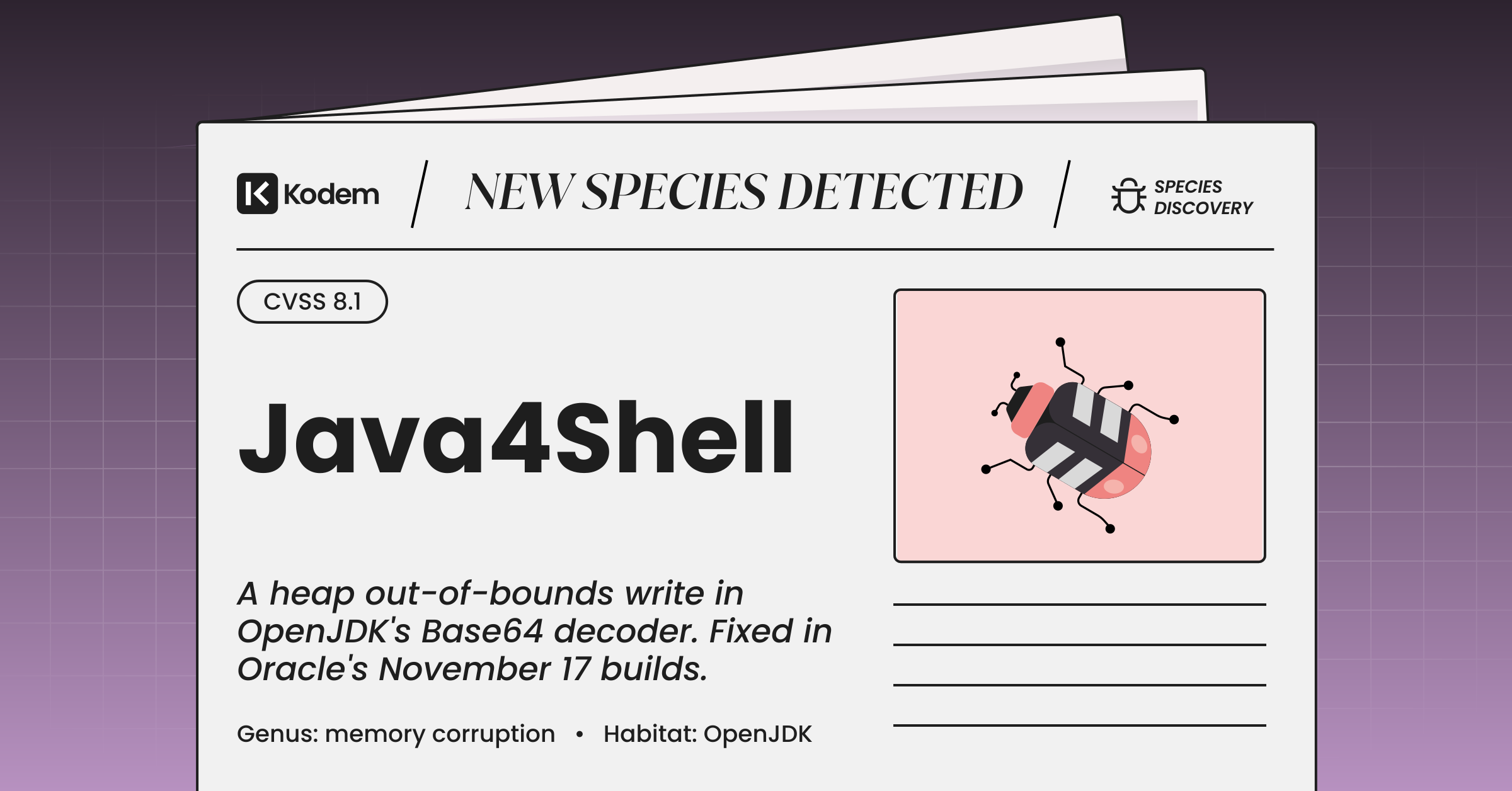
Java4Shell: CVE-2026-114938 Explained, With Fixed Versions and the First-Hour Runbook

DRAFT OUTLINE. NOT FOR PUBLICATION. This is the writer brief for the Java4Shell post, staged on November 17, 2026. Replace every section below with finished copy. Full brief, keyword strategy, sources, and open items: Java4Shell blog brief. Primary keyword: java4shell. Target length: 1,800 to 2,400 words. No em-dashes.
Opening paragraph. Anchor the primary keyword in the first sentence: Java4Shell (CVE-2026-114938) is a heap out-of-bounds write in OpenJDK's hardware-accelerated Base64 decoder, disclosed by Calif on November 17, 2026 and fixed the same day in Oracle's builds. Say who it is for (teams running Java 17, 21, 25, or 27 on x86-64, especially services that decode Basic auth headers or JWTs). State the calibration early: the memory corruption is confirmed by OpenJDK and reproduced by third parties. Remote code execution in named products is Calif's claim, and the exploit chains are withheld.
What Java4Shell is: a heap overflow in OpenJDK's Base64 decoder
Answer first: Java4Shell (CVE-2026-114938) is a heap out-of-bounds write in the AVX-512 Base64 decode intrinsic inside OpenJDK's HotSpot JVM. An unauthenticated attacker who gets a malformed Base64 string to java.util.Base64 on an affected host can corrupt heap memory, and Calif reports chaining that to heap disclosure and remote code execution.
| Fact | Detail |
|---|---|
| CVE | CVE-2026-114938 |
| Name | Java4Shell (named by Calif) |
| Component | OpenJDK HotSpot, hotspot/compiler: the x86-64 AVX-512 Base64 decode intrinsic |
| Bug class | Heap out-of-bounds write (CWE-787 class) |
| Severity | 8.1 on CVSS 3.1 per OpenJDK and Oracle (AV:N/AC:H/PR:N/UI:N/S:U/C:H/I:H/A:H). 9.2 on CVSS 4.0 per Calif |
| Introduced by | JDK-8268276 (JDK 18, June 2021), backported to 17.0.6 (January 2023) |
| Found by | Quang Luong, Calif |
| Disclosed and patched | November 17, 2026 |
| Exploitation | None reported. Not in CISA KEV as of November 17, 2026 |
| Java line | Affected builds | Oracle fixed build |
|---|---|---|
| 8 | Not affected. Exception: 8u511-perf (Enterprise Performance Pack) | Not applicable |
| 11 | Not affected | Not applicable |
| 17 | 17.0.6 through 17.0.21.0.3 | 17.0.21.1 |
| 21 | 21.0.13.0.3 and earlier | 21.0.13.1 |
| 25 | 25.0.5.0.3 and earlier | 25.0.5.1 |
| 26 | Affected. Non-LTS, updates ended, no fix coming | None |
| 27 | 27.0.1.0.3 and earlier | 27.0.1.1 |
Add: Temurin, Corretto, Azul Zulu, Microsoft, and Red Hat builds carry the same code and ship fixes under their own version labels. Recheck their status at publish.
Exposure needs all four conditions:
- An affected JDK build.
- An x86-64 CPU with AVX-512 F, BW, VBMI, and BMI2 (Intel Ice Lake or newer, AMD Zen 4 or newer; AWS c6i, m6i, c7i, c7a, m7a). ARM64, including Graviton, is not affected.
- The C2 JIT has compiled the decode path with
UseBASE64Intrinsicson (the default). - Attacker-controlled bytes reach
java.util.Base64(basic or URL-safe decoder).
How the Java4Shell attack chain executes
Answer first: One malformed, padded Base64 token makes the decoder write a full 64-byte vector past the end of its output array before Java rejects the input. Everything after that is application-specific: heap grooming turns the fixed write into a heap read, then into code execution.
Initial execution: warming the decoder
The vulnerable code only runs after C2 compiles the decode method. An attacker reaches that state by sending valid Base64 until the method is hot.
The trigger: a malformed padded tail
- The stub builds a store mask from the expected output length, minus one byte per
=pad. With certain malformed tails the length underflows to -1 or -2,bzhileaves every mask bit set, and the masked store (evmovdqub) writes all 64 lanes. - Worked example: a 50-byte output array takes a 64-byte write at offset 48, so 62 bytes land out of bounds.
- The JVM throws
IllegalArgumentExceptiononly after the write. Catching it does not help.
Heap disclosure
The fixed write overwrites an adjacent array's length field, and an oversized array gets copied into the HTTP response. What leaks: session tokens, API keys, database credentials, TLS private keys.
Code execution and reach
Calif reports escalating the bounded write to arbitrary writes that reach the JIT code cache, running as the JVM's OS user.
| Reach | Products named by Calif (default configurations) |
|---|---|
| Pre-auth RCE | Keycloak, Atlassian Jira, Atlassian Confluence, JFrog Artifactory, Jenkins, PingFederate |
| Post-auth RCE | Apache Kafka, Apache Solr, Elasticsearch, Gerrit, Spinnaker |
| Entry point | Code path |
|---|---|
Authorization: Basic header | Spring Security BasicAuthenticationConverter, Tomcat BasicAuthenticator, Jetty BasicAuthenticator |
| JWT header and payload | Auth0 java-jwt (decodes before verifying the signature). jjwt and nimbus-jose-jwt use their own Base64 code |
| Request bodies | Base64 fields in JSON, XML, or form data |
| WebSocket frames | After upgrade, where proxy body buffering no longer applies |
Why Java4Shell is not Log4Shell: a runtime bug, not a library bug
Answer first: Log4Shell was a logic flaw in one library that any dependency scanner could find by name and any attacker could trigger with one string. Java4Shell is memory corruption inside the JVM itself, and whether a workload is exposed depends on the CPU it lands on.
| Log4Shell | Spring4Shell | Java4Shell | |
|---|---|---|---|
| CVE | CVE-2021-44228 | CVE-2022-22965 | CVE-2026-114938 |
| Where the bug lives | log4j-core library | Spring Framework | OpenJDK HotSpot runtime |
| Bug class | JNDI lookup injection | Data-binding abuse | Heap out-of-bounds write |
| Where it shows up | pom.xml, lockfile, SBOM | pom.xml, lockfile, SBOM | Base image, OS package, bundled JDK |
| Hardware-dependent | No | No | Yes (AVX-512 VBMI) |
| Exploit effort | One string, any target | Specific deployment shape | Application-specific heap grooming |
- The bug sat in a hot path for over five years (June 2021 to November 2026).
- AI-assisted discovery. Verify Calif's exact figures before quoting them.
- Second runtime-level bug from the same firm in a month. Link the PHP2Shell post.
- It leaked before the patch: a Korean NCSC advisory on November 16 to 17, then Oracle's builds, the OpenJDK advisory, and Calif's write-up on November 17.
Indicators of compromise and behavioral signals for Java4Shell
Answer first: Java4Shell has no file hash or C2 domain to block. Hunt for three things on AVX-512 hosts: the malformed token shape, the decoder exception it produces, and JVM crashes since November 17, 2026.
JDK builds to flag
- OpenJDK
17.0.6through17.0.21.0.3, and Java 21, 25, 26, and 27 builds released before November 17, 2026, from any vendor. - JDKs bundled inside products. These need the vendor's release.
Request indicators
- A Base64-alphabet token of 32 or more characters that ends in
=and whose length is not a multiple of 4. Start withAuthorization: Basicheaders, then JWT segments. - A burst of valid Base64 requests from one source followed by malformed ones.
Application log indicators
java.lang.IllegalArgumentExceptionfromjava.util.Base64$Decoderreporting a wrong 4-byte ending unit.- The HTTP response is a plain 401.
Process and host indicators
- SIGSEGV in a JVM, new
hs_err_pid*.logfiles, or bursts of worker restarts on internet-facing x86 services. - After any of the above: a JVM spawning a shell, writing outside its working paths, or opening new outbound connections.
Not an indicator: GitHub PoC repositories. Fake ones have already appeared.
Immediate response: the first-hour runbook
Answer first: Patch internet-facing Java on AVX-512 hosts first. Where a patch cannot land within the hour, start the JVM with -XX:-UseBASE64Intrinsics, restart, then hunt and rotate.
- Inventory running JVMs, not manifests.
ps -eo pid,args | grep '[j]ava',readlink -f /proc/<pid>/exe,jcmd <pid> VM.version. Runjava -versioninside the container. - Check the hardware gate.
grep -m1 '^flags' /proc/cpuinfo | tr ' ' '\n' | grep -E '^(avx512f|avx512bw|avx512vbmi|bmi2)$'. All four flags printed means the vulnerable path can run. - Rank by reach. Internet-facing services that accept Basic auth or parse JWTs with
java-jwt, plus Keycloak, Jira, Confluence, Artifactory, Jenkins, and PingFederate. - Patch. Oracle
17.0.21.1,21.0.13.1,25.0.5.1, or27.0.1.1, or the vendor equivalent. Rebuild images, restart, confirm withjcmd. - Mitigate what cannot be patched yet.
-XX:-UseBASE64Intrinsicsand restart.-XX:UseAVX=2is a secondary option on x86-64 only. Do not push-XX:DisableIntrinsic=_base64_decodeBlockwithout-XX:+UnlockDiagnosticVMOptionsbefore it: the JVM fails to start. - Hunt back to November 17, 2026 for the token shape, the decoder exception, and
hs_err_pid*.logfiles. - Rotate where you find hits. Session signing keys, API tokens, database credentials, TLS private keys.
- Close the admin surfaces. Restrict network access to identity, CI, and artifact systems until they run a fixed build.
Include: upgrading Spring, Tomcat, or Jetty does not fix this. Only the JDK update does.
Why dependency scanners see nothing and version checks see too much
Answer first: SCA reads manifests and lockfiles, and the JDK is in neither. A version check finds every Java 17+ install, but only the JVMs on AVX-512 VBMI hardware with untrusted Base64 reaching a JIT-compiled decoder can be hit.
- The JVM arrives through a base image, an OS package, a tarball, or a vendor bundle.
pom.xmlandbuild.gradlenever name it. - Exposure is a runtime fact. The same image is exposed on a c7i node and safe on Graviton.
- The exception fires after the write, so application error handling sees an ordinary 401.
- Kodem positioning, general capabilities only: container scanning and runtime package usage, runtime intelligence, ADR, Kai, with a link to SCA. Positioning limits are in the brief's Writer Notes. Research sign-off needed before any Java4Shell-specific claim.
Hardening Java workloads against the next Java4Shell
Answer first: Assume more runtime-level bugs are coming. Treat the JDK as a dependency with an owner, and keep a tested mitigation profile ready before the next advisory lands.
- Track the JDK like a dependency. Vendor, build, owner, and location for every runtime.
- Rebuild base images on a schedule. Oracle now ships Java security releases monthly.
- Retire non-LTS lines in production. Java 26 is affected and gets no fix.
- Keep an intrinsics-off JVM profile tested. Know the cost of
-XX:-UseBASE64Intrinsicsbefore you need it. - Validate Base64 shape at the edge. Friction, not a fix.
- Treat JVM crashes as security events. Route
hs_err_pid*.logcreation to the security queue. - Know your silicon. Record which node pools expose AVX-512 VBMI.
What Java4Shell signals about runtime-level risk
Answer first: The memory-safe language did not fail. The hand-written assembly underneath it did, and AI-assisted research is now reading that layer faster than fleets get patched.
- Intrinsics and JIT stubs are attack surface in every managed runtime.
- Discovery got cheap.
- Leaks compress the window, so the mitigation flag mattered more than the upgrade plan.
Prediction to state plainly: by the end of Q1 2027, at least one more memory-corruption CVE will be published in a hand-written SIMD intrinsic of a managed runtime (HotSpot, .NET, V8, or Go assembly), credited to AI-assisted research.
Frequently Asked Questions
- What is Java4Shell? Java4Shell (
CVE-2026-114938) is a heap out-of-bounds write in OpenJDK's AVX-512 Base64 decoder. A malformed Base64 string can corrupt JVM heap memory before authentication, and Calif reports chaining it to remote code execution. - Which Java versions are affected by CVE-2026-114938? OpenJDK
17.0.6through17.0.21.0.3, and Java 21, 25, 26, and 27 builds released before November 17, 2026. Oracle's fixed builds are17.0.21.1,21.0.13.1,25.0.5.1, and27.0.1.1. - Are Java 8 and Java 11 affected? No. They do not contain the Base64 decode intrinsic. The one exception is Oracle's
8u511-perfEnterprise Performance Pack. - Am I exposed on ARM or AWS Graviton? No. The vulnerable code runs only on x86-64 CPUs with AVX-512 VBMI.
- How do I mitigate Java4Shell without patching? Start the JVM with
-XX:-UseBASE64Intrinsicsand restart the service. Remove the flag once the JDK is patched. - How do I know if someone tried to exploit Java4Shell? Look for padded Base64 tokens of 32 or more characters whose length is not a multiple of 4,
IllegalArgumentExceptionfrom the Base64 decoder, and unexplained JVM crashes since November 17, 2026. - Is Java4Shell being exploited in the wild? No exploitation was reported as of November 17, 2026, and it is not in CISA KEV. Calif is withholding its exploit chains.
- How is Java4Shell different from Log4Shell? Log4Shell was a library flaw that dependency scanners find by name. Java4Shell lives in the Java runtime, depends on the host CPU, and needs application-specific work to exploit.
Format the FAQ with the site's accordion markup at write time (see the PHP2Shell post).
The bottom line
CTA lead-in: Which JVMs are running, on which hosts, and what they do when a malformed token arrives are runtime questions. Kodem ADR watches application behavior in production, and Kai turns version, runtime, and detection context into one ranked list. See Kodem ADR in action.
References
Related blogs
ARTEX AI Pentest Framework: Backdoored Docker Image, IOCs, and Response Runbook
ARTEX is the open-source AI pentest framework behind the FBI FLASH alert of November 2026. How ARTEX works, the backdoored Docker image, IOCs, and a runbook.
13
Stop the waste.
Protect your environment with Kodem.
The State of the Application Security Workflow
This report aims to equip readers with actionable insights that can help future-proof their security programs. Kodem, the publisher of this report, purpose built a platform that bridges these gaps by unifying shift-left strategies with runtime monitoring and protection.

Get real-time insights across the full stack…code, containers, OS, and memory
Watch how Kodem’s runtime security platform detects and blocks attacks before they cause damage. No guesswork. Just precise, automated protection.