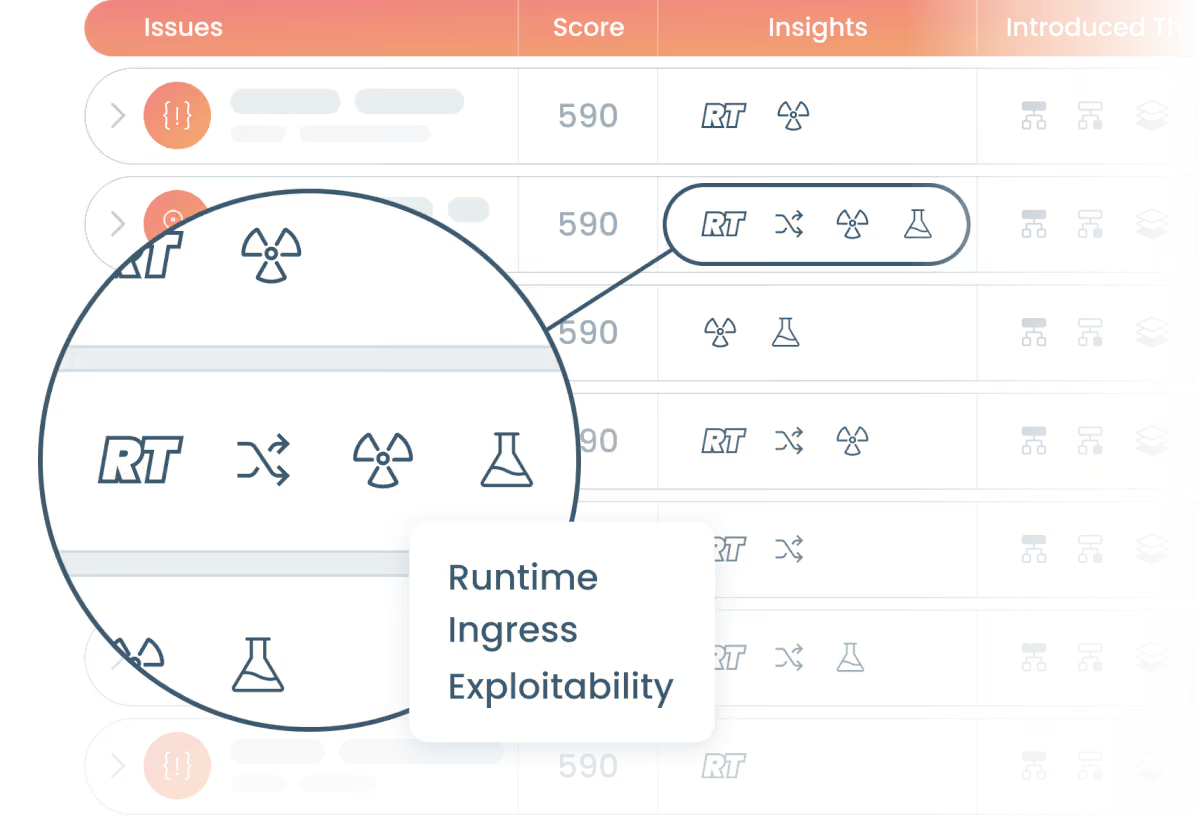

Kodem Security Joins the GKE Autopilot Partner Ecosystem
Kodem Security is now an approved GKE Autopilot Partner, enabling Kodem’s runtime-first application security platform to operate natively within Google Kubernetes Engine (GKE) Autopilot clusters.
GKE Autopilot delivers a fully managed Kubernetes experience by abstracting away node management, scaling and infrastructure operations. To preserve that model, Autopilot enforces strict controls on workloads that require elevated permissions. Only reviewed and allowlisted partner solutions are permitted to run privileged components.
Kodem’s inclusion in the Autopilot partner ecosystem means customers can deploy Kodem’s runtime intelligence in Autopilot clusters without relaxing platform guardrails, introducing unmanaged components or compromising security posture.
This milestone reflects a shared commitment between Kodem and Google Cloud to deliver production-grade security in modern, fully managed Kubernetes environments.
Why This Partnership Matters
Security That Preserves the Autopilot Contract
Autopilot is built on a simple promise: teams should not have to manage nodes, kernel settings or low-level infrastructure. That promise requires strong enforcement boundaries around what workloads are allowed to do.
Autopilot partners undergo a formal review and allowlisting process to ensure their workloads require elevated access only when necessary and only within tightly defined constraints. This enables advanced security and observability tooling to function without eroding Autopilot’s security model.
For customers running critical production workloads, this removes a long-standing tradeoff between runtime visibility and platform integrity.
Runtime Insight Without Infrastructure Exceptions
Historically, runtime security tools often required operational workarounds, including custom node pools, privileged DaemonSets or unsupported configurations that undermined managed Kubernetes environments.
As a GKE Autopilot Partner, Kodem operates as a first-class workload within Autopilot. Customers gain runtime execution evidence and production visibility without creating exceptions, managing nodes or stepping outside Google Cloud best practices.
What This Enables for Kodem Customers
Runtime Evidence in Fully Managed Kubernetes
As an Autopilot partner, Kodem can deploy its runtime sensors in a way that is compatible with Autopilot’s enforcement model. This enables teams to:
- Verify which vulnerable functions actually execute in production.
- Correlate repository findings, container images and runtime behavior.
- Tie vulnerability risk directly to live Kubernetes workloads.
Rather than relying on theoretical exposure, security and engineering teams gain concrete, function-level execution evidence, while continuing to operate in a fully managed Kubernetes environment.
Enterprise-Ready Assurance and Consistency
Autopilot partner workloads are governed by Google-managed allowlists that define exactly which permissions and capabilities are granted. These allowlists are synchronized automatically and applied consistently across clusters.
For regulated environments and security-conscious organizations, this provides an auditable, repeatable deployment model that aligns with enterprise risk requirements and platform security expectations.
Kodem’s Runtime-First Approach on GKE Autopilot
Kodem is built around a simple principle: security decisions should be based on what actually runs, not what might run.
On GKE Autopilot, Kodem extends this approach by:
- Observing runtime execution paths within containerized applications.
- Tracking which vulnerable code paths and packages are actually loaded.
- Reducing alert noise by eliminating issues that never execute in production.
Rather than treating Kubernetes as just another deployment target, Kodem integrates runtime intelligence directly into Autopilot environments, preserving developer velocity while improving prioritization for security, risk, and compliance teams.
This is especially critical in Autopilot, where teams expect security tooling to adapt to the platform, not require platform exceptions.
Together with Google Cloud
Kodem’s recognition as a GKE Autopilot Partner represents more than technical compatibility. It reflects a shared approach to modern cloud security: strong defaults, minimal exceptions, and evidence-driven decisions.
Together with Google Cloud, Kodem enables organizations to:
- Adopt fully managed Kubernetes without sacrificing runtime security
- Reduce vulnerability noise through execution-based prioritization
- Operate confidently in regulated and production-critical environments
Autopilot simplifies Kubernetes operations. Kodem ensures security decisions remain grounded in reality.
Related blogs
Kodem Security Joins OpenAI's Daybreak Cyber Partner Program
Kodem Security joins OpenAI's Daybreak, putting frontier reasoning inside the runtime system that discovers, governs, protects, and responds across apps and AI agents.
3

Introducing Runtime Application Defense for WAF Environments
Turning perimeter security into full-spectrum application defense
3
How Rapyd Used Kodem to Shift from Volume to Impact
Rapyd, a global fintech platform operating in over 100 countries, partnered with Kodem to modernize its application security program. Faced with mounting vulnerabilities and a shortage of specialized AppSec talent, Rapyd needed more than another scanner—it needed a platform that could think like an expert. Kodem delivered measurable reductions in triage time, rework, and risk exposure by focusing on what attackers can actually exploit.
Stop the waste.
Protect your environment with Kodem.
The State of the Application Security Workflow
This report aims to equip readers with actionable insights that can help future-proof their security programs. Kodem, the publisher of this report, purpose built a platform that bridges these gaps by unifying shift-left strategies with runtime monitoring and protection.
.avif)
Get real-time insights across the full stack…code, containers, OS, and memory
Watch how Kodem’s runtime security platform detects and blocks attacks before they cause damage. No guesswork. Just precise, automated protection.