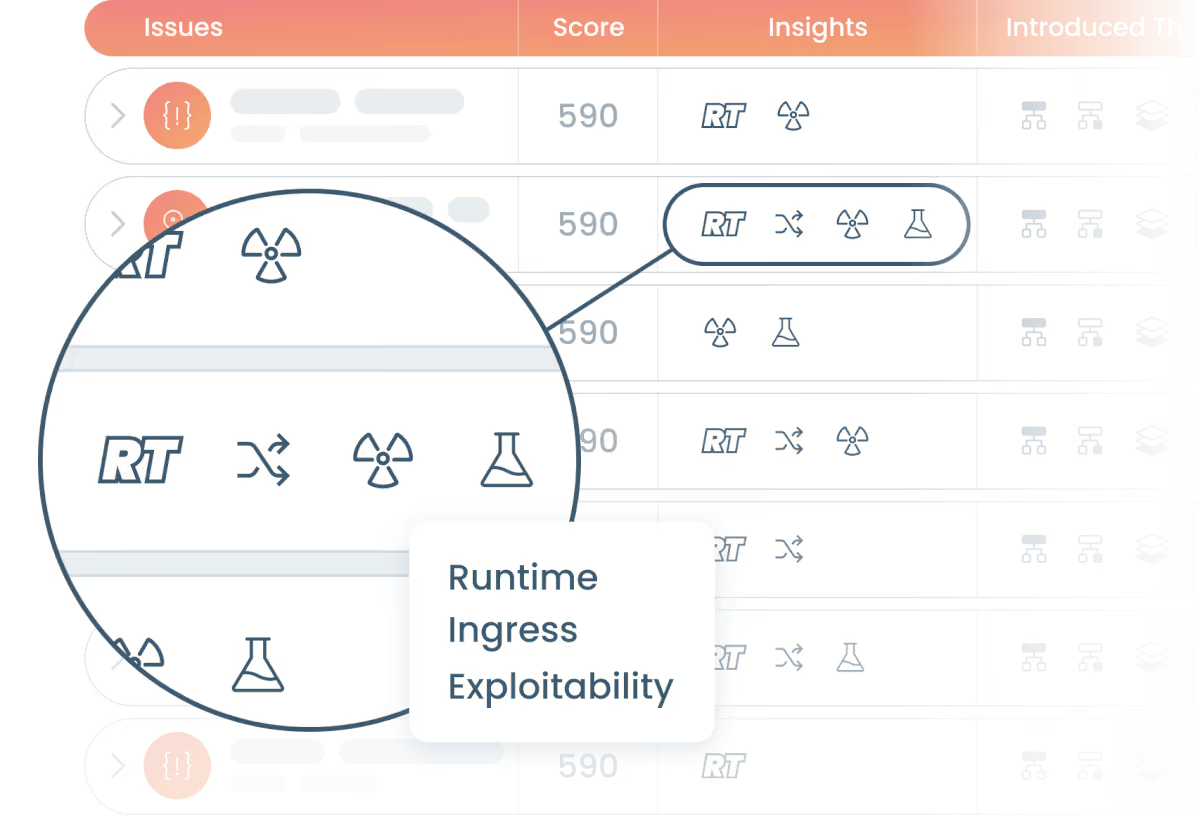
Turn the Lights On: AI Governance Through Runtime Enforcement
Operationalizing AI Governance Across the SDLC


Enterprise AI governance is rapidly evolving from discovery to visibility. Organizations have begun identifying where AI exists and, more recently, illuminating how AI behaves at runtime. Nevertheless, true governance demands more than just visibility, it requires enforcement.
Most AI governance initiatives begin with policy definition. Organizations establish rules governing model usage, data access, prompt safety and agent permissions. These policies are often formalized through governance frameworks, security standards, and internal compliance controls. Yet the existence of policy doesn’t guarantee enforcement.
This distinction represents a critical gap in emerging AI governance models. Discovery identifies AI usage. Runtime illumination reveals behavior. But governance only becomes operational when policies can be validated and enforced during execution. This represents the next phase of AI governance maturity: runtime enforcement.
The Enforcement Gap in AI Governance
Traditional governance models rely on static control points across the development and deployment lifecycle. These mechanisms assume that risk can be identified before execution or at system boundaries.
Common governance controls include:
- Code reviews.
- CI/CD policies.
- Model allowlists.
- API gateways.
- Network monitoring.
These controls provide guardrails, but they don’t guarantee compliance. AI-driven systems introduce dynamic behavior that emerges during execution rather than configuration.
AI systems increasingly:
- Modify execution paths through AI-generated code.
- Dynamically invoke tools and APIs.
- Alter control flow based on model output.
- Introduce dependencies at runtime.
- Execute logic influenced by prompt context.
These characteristics shift governance enforcement from static boundaries to runtime behavior. As a result, policies that rely solely on development-time or network-based controls can’t reliably enforce AI governance.
This creates the enforcement gap:
- Policies exist.
- Controls are configured.
- Behavior remains unvalidated.
Runtime as the Enforcement Layer
The emergence of AI systems fundamentally transforms governance. While traditional governance focuses on validating configuration, runtime governance is centered on validating behavior. This signifies a shift in governance from focusing on initial intent to monitoring observable behavior.
Traditional governance asks:
- Was the system configured correctly?
- Were policies applied?
- Were controls enabled?
Runtime governance asks:
- What executed?
- What data was accessed?
- What actions were performed?
- Were policies violated during execution?
This shift transforms governance from static validation to continuous enforcement. Runtime enforcement enables:
- Behavior-based governance.
- Execution-aware validation.
- Continuous compliance enforcement.
- Policy enforcement across dynamic systems.
Example 1: Governing Data Exposure in AI Workflows
AI agents present a challenge to traditional governance, as they dynamically construct requests and data flows at runtime, unlike static enforcement mechanisms that rely on configuration and code-level controls.
Organizations typically deploy governance policies to prevent sensitive data transmission to external models. However, an integrated AI assistant, such as one used in customer support, illustrates the limitation of static policies. The assistant may retrieve user records, summarize context and transmit this information to a model endpoint. In such scenarios, sensitive data exposure can still occur despite configured static policies. Therefore, governance is truly enforceable only when runtime behavior is continuously validated.
Runtime enforcement validates:
- Data retrieval operations.
- Prompt composition.
- Model invocation behavior.
- Outbound data transmission.
Without runtime enforcement:
- Policies can’t validate data exposure.
- Governance controls can’t confirm compliance.
- Risk remains theoretical.
Example 2: Enforcing AI Agent Boundaries
AI agents, through their capacity for dynamic tool invocation, pose significant challenges to existing governance frameworks. When granted tool access, or when safeguards are bypassed through prompt manipulation, AI agents may interact with internal systems, infrastructure, and sensitive data. Traditional governance policies attempt to restrict these capabilities, but dynamic agent behavior complicates enforcement.
However, the nature of agent behavior, which is driven by prompts, complicates enforcement. This essential shift necessitates a move in governance focus: from enforcing static configurations to enforcing dynamic behavior.
Agents may dynamically invoke:
- File system access.
- Database queries.
- Internal APIs.
- Infrastructure automation tools.
Prompt injection attacks demonstrate this risk. A malicious prompt may instruct the agent to retrieve secrets or perform privileged actions. These behaviors emerge during execution.
Runtime enforcement validates:
- Tool invocation sequences.
- Data access patterns.
- Privilege escalation attempts.
- Policy violations during execution.
Example 3: Governing AI-Generated Code
AI-generated code introduces significant governance challenges throughout the SDLC) As developers increasingly use AI assistants to create application logic, dependencies, and configurations, the resulting changes may introduce risks that only become apparent during execution. Consequently, the focus of governance is shifting from theoretical compliance to the observation of actual behavior.
AI-generated code may introduce:
- Unsafe deserialization.
- Injection vulnerabilities.
- Hardcoded credentials.
- Insecure defaults.
- Vulnerable dependencies.
Static governance controls validate code structure and configuration, while runtime enforcement validates observed execution behavior. This distinction is critical for AI-generated code, where risk often emerges only during execution rather than at development time.
Runtime enforcement enables validation of:
- Reachable execution paths.
- Runtime dependency loading.
- Unsafe function invocation.
- Exploitability conditions.
AI Governance Across the SDLC
AI governance must extend beyond production environments. Enforcement must apply continuously across the entire software development lifecycle.
Development
Runtime enforcement validates:
- AI-generated logic.
- Dependency behavior.
- Execution risk.
CI/CD
Runtime enforcement validates:
- Execution paths introduced by AI-generated changes.
- Policy compliance prior to deployment.
- Runtime behavior before release.
Production
Runtime enforcement validates:
- Agent behavior.
- Model-driven execution.
- Dynamic policy enforcement.
Runtime Enforcement as Continuous Governance
Traditional governance models are based on the premise of static systems. However, AI introduces dynamic execution behavior that continuously evolves, necessitating a shift in governance. Governance must transition its focus from static documentation to operational control and continuous validation to adapt to the evolving nature of AI systems.
Runtime enforcement enables:
- Continuous compliance validation.
- Dynamic policy enforcement.
- Execution-aware governance.
- Behavior-based risk prioritization.
The Future of AI Governance
AI governance is evolving beyond visibility to encompass runtime enforcement. By acting as the enforcement layer, runtime translates governance policy directly into practice.
Organizations are recognizing that:
- Discovery identifies AI usage.
- Runtime illumination reveals behavior.
- Runtime enforcement validates governance.
Without enforcement:
- Governance remains theoretical.
- Policies remain unenforced.
- Risk remains unvalidated.
Turn the Lights On and Enforce
AI governance is progressing through a clear maturation path. Discovery identifies where AI exists. Illumination reveals how it behaves. Enforcement ensures that behavior aligns with policy. Without enforcement, governance remains observational rather than operational.
AI systems introduce dynamic execution paths, agent-driven workflows and model-influenced decision logic that evolve over time. In this environment, governance can’t rely solely on configuration, documentation or static controls. Policies must be continuously validated against observed behavior.
Runtime enforcement provides this missing layer. By validating execution, data access, and decision pathways as they occur, organizations can move beyond theoretical governance toward measurable, enforceable controls across the SDLC.
In this model, governance becomes:
- Continuous rather than periodic.
- Behavioral rather than declarative.
- Execution-aware rather than configuration-driven.
- Enforceable rather than aspirational.
Turning the lights on is no longer sufficient. Governance requires enforcement at runtime, where AI systems execute, adapt, and introduce risk.
References
- Anthropic. (2024). Building safe and reliable AI agents. Anthropic
- Gartner. (2023). AI TRiSM: AI trust, risk and security management. Gartner Research.
- Google DeepMind. (2024). Evaluating risks and safety in autonomous AI agents. Google Deepmind
- Microsoft. (2024). Prompt injection attacks and defenses for AI systems. Microsoft Security
- National Institute of Standards and Technology. (2023). Artificial Intelligence Risk Management Framework (AI RMF 1.0). U.S. Department of Commerce. NIST
- OpenAI. (2024). Function calling and tool usage with language models.OpenAI
- OWASP Foundation. (2023). OWASP Top 10 for large language model applications. Open Worldwide Application Security Project
Related blogs
Top 5 AI SAST Tools in 2026
AI SAST tools promise less noise and automatic fixes. Five tools compared on the six criteria that matter, and what the independent research shows.
15


Stop the waste.
Protect your environment with Kodem.
The State of the Application Security Workflow
This report aims to equip readers with actionable insights that can help future-proof their security programs. Kodem, the publisher of this report, purpose built a platform that bridges these gaps by unifying shift-left strategies with runtime monitoring and protection.
.avif)
Get real-time insights across the full stack…code, containers, OS, and memory
Watch how Kodem’s runtime security platform detects and blocks attacks before they cause damage. No guesswork. Just precise, automated protection.